An unedited version of the article that appeared in
the Feb-March 2002 issue of Salt Water Fly Fishing
by Capt. Scott Sparrow
Last January,
a certain Monday dawned windless and clear -- a perfect day for fly fishing
on the lower Laguna Madre. I had a few errands to run in Harlingen,
Texas, but I agitated inwardly until I couldn't stand it any longer. Finally
I called Kathy on the cell phone and said, "Let's go fishing." I don't
remember having to persuade her.
It was
about 75 degrees when I arrived home, so I decided to wade
wet. As usual, Kathy was decked out in a fleece top, and had packed her
waders on the boat just in case. She proceeded to give me the predictable
lecture about needing to take precautions against the chill -- but hey
- what 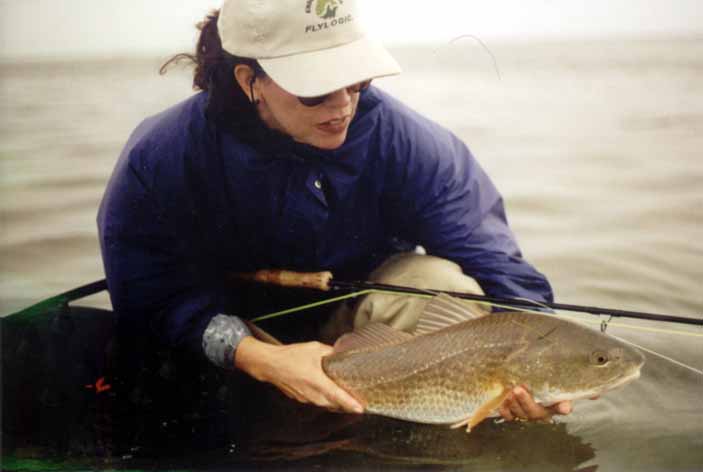 chill?
The day was just too spring-like to be burdened with such things. As we
boated eastward down the Arroyo Colorado toward the lower Laguna Madre,
feeling the intermittently cool and balmy air of a south Texas January
afternoon, I thought that winter fishing on the lower Laguna had to be
just about as good as it gets.
chill?
The day was just too spring-like to be burdened with such things. As we
boated eastward down the Arroyo Colorado toward the lower Laguna Madre,
feeling the intermittently cool and balmy air of a south Texas January
afternoon, I thought that winter fishing on the lower Laguna had to be
just about as good as it gets.
We came
to the mouth of the Arroyo Colorado, turned south into the Intercoastal
Waterway, and then ventured onto the glassy, clear flats. The tides
were seasonally low, and the flats were alive with churning mullet -- a
sure sign that the sun had warmed the water enough to draw the reds and
speckled trout back into the shallows. Before we'd gone a hundred yards,
we noticed numerous wakes retreating from the boat's intrusion. We shut
down in 12 inches of water and fiddled with our gear, giving the fish some
time to resume their natural feeding patterns. In less then five minutes,
we began to see redfish tails popping up all around, scattered among the
flickering tails of feeding sheepshead.
Staking
the boat with the push pole, we slipped into the water armed with lightweight
shrimp patterns. I had to admit that the first step was a chilly one --
but only to myself, of course. I warmed up considerably a few minutes later
after casting to a tailing 25-inch red who ate my fly without hesitation.
Kathy -- who still considered herself a novice at the time -- caught and
released two 24-inch reds before a gentle northwest breeze informed us
that a cold front would soon be passing through.
I believe it was the Greek mathematician Thales who once wrote, "Tis better to love all the seasons than to fall hopelessly in love with spring." To some fly fishers, this means hanging up the rods in the autumn and gracefully turning to other interests. To others, it just means finding a place where they can fish without getting hypothermia. While tropical fly fishing venues abound in various far flung parts of the world, some of the most precious places can be, as Parcifal was told in his search for the Grail castle, just "down the road and across the bridge" -- like, for example, the lower Laguna Madre of deep south Texas.
The lower
Laguna is a shallow, usually clear, subtropical estuary that lies between
the mainland of southernmost Texas and Padre Island, the longest barrier
island in the world. Stretching over 60 miles from north to south, and
averaging about five miles wide, the lower Laguna is so vast that few fishermen
can claim to have explored it completely. An incredible array of fortunate
circumstances have protected it from the encroachment of modern life. Some
of the largest cattle ranches in the United States claim almost the entire
western shoreline northward of where the Arroyo Colorado -- a river-like
tributary -- joins the Laguna. Having maintained the shoreline as
pasture for the first hundred years of its existence, the ranch owners
now actively cooperate with the state to limit the impact of runoff and
development on the fragile ecosystem. And then, to the south of the
Arroyo Colorado, the Laguna Atascosa National Wildlife Refuge effectively
insulates the western shoreline of the lower Laguna for another fifteen
miles.
On the
northeastern side of the Bay, Padre Island National Seashore protects the
scenic estuary from further encroachment. Only the southern tip of Padre
Island bears the imprint of modern civilization, with its high-rise hotels
rising surreally above an otherwise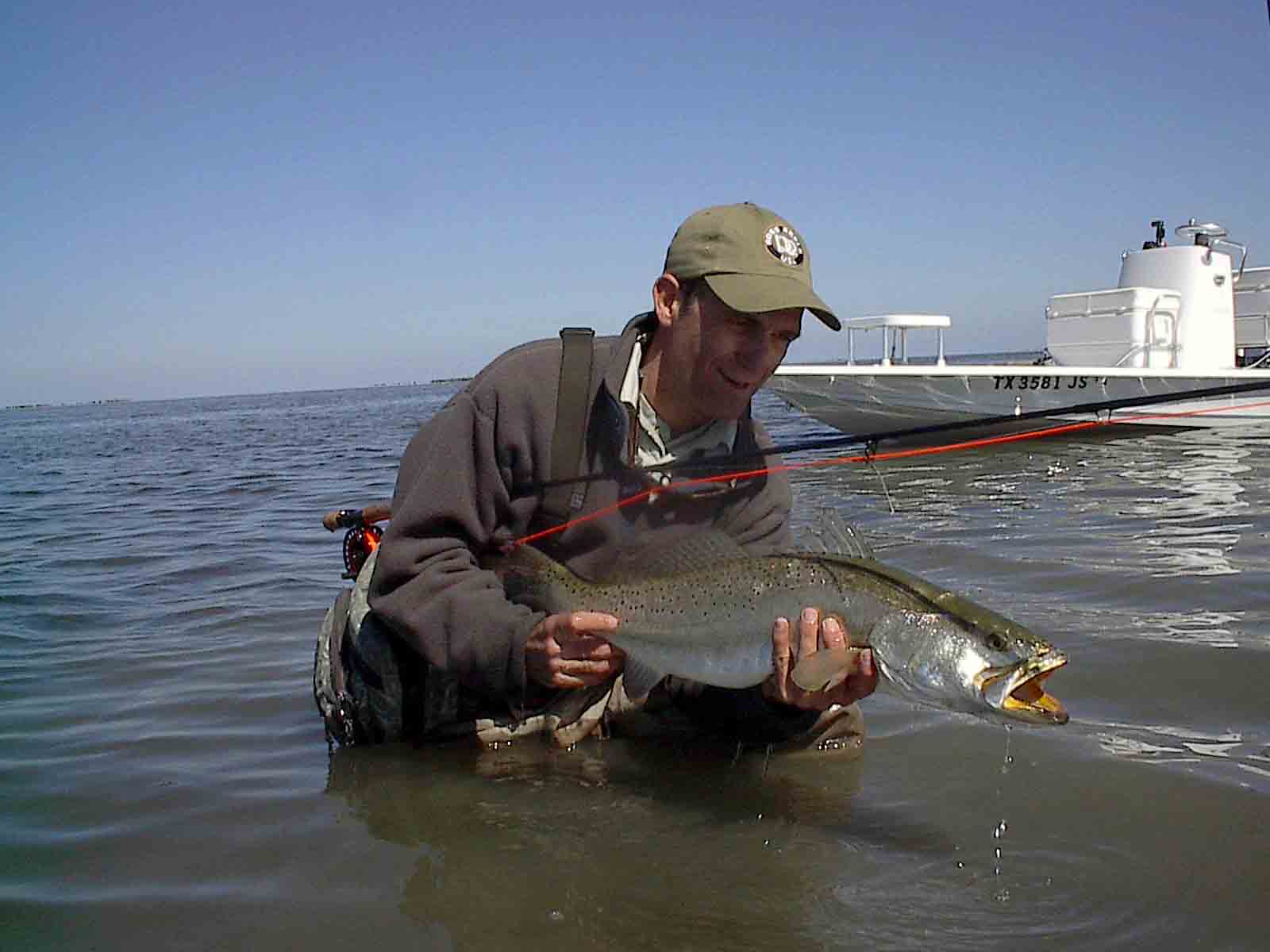 unmarred horizon. Except for
this distant reminder of modern life, the lower Laguna remains pretty much
as it has always been, and survives as one of the last remaining primitive
estuaries in the world.
unmarred horizon. Except for
this distant reminder of modern life, the lower Laguna remains pretty much
as it has always been, and survives as one of the last remaining primitive
estuaries in the world.
The lower
Laguna Madre is a year-round fly fishery that remains, as yet, virtually
unknown and untapped during the winter months. Even among locals, who would
presumably know about it’s off-season potential, I have found a lot
of resistance to the notion that the fishing can be so good during the
winter months. I've interviewed a few, and I know that there are three
beliefs that tend to keep fisherman away from the Bay in the winter:
* There's not enough water
to get around in a boat.
* The fish leave the Bay.
* Even if some of the redfish
do stick around, they don't tail in the wintertime.
Because
I never fished the lower Laguna in the winter months until recently --
having lived most of my adult life on the East Coast -- I always assumed
these assumptions were true, and never thought to plan my fishing trips
to my home waters in the "off" season. But after moving back, and fly fishing
the lower Laguna during the warmest and coldest winters on record -- 2000
and 2001 -- I have discovered that these beliefs are largely unfounded.
Nevertheless, let us fairly consider their merits.
There's
not enough water to get around. It is true that the mid-winter tides
-- like the mid-summer tides -- are often so low that only the shallowest-running
boats can venture safely beyond the Intercoastal Waterway. But for fly
fishers who specialize in sight casting, and who have skiffs that can negotiate
the shallowest waters, the ultra skinny water is like a briar patch into
which they dearly love to be thrown. Even if a fly fisher only has a deep-draft
boat, there are endless options for parking the boat along the channel,
and then wading or kayaking onto the flats.
Further,
the fish are more visible when there is less water in the estuary. If the
sun is out, they are easy to see just below the surface, and if it's cloudy,
their backs and tails often protrude above the surface as they cruise and
feed. In contrast, during the seasonal high tides of spring and fall,
I sometimes boat for miles on a cloudy day without ever spotting a fish;
and so, ironically, finding and catching fish during the winter months
can often seem much easier than during the "high season" of spring and
fall.
The fish
leave the Bay. I was visiting with my friend and local fly fisher
Bud Rowland last March. He'd fished and duck hunted the South Bay of
the lower Laguna Madre with his sons all winter, and he had kept a log
of his hunting and fishing results. He opened the little notebook, and
began reading a list of the big speckled trout he'd caught. After he'd
recounted several impressive mid-winter catches, he turned to me and said,
"Scott, people think the fish aren't there in the winter. But they’re always
there."
According to
Randy Blankenship, staff biologist with the Texas Dept. of Parks and Wildlife,
Bud is dead right. Except for spawning-size redfish -- this is, fish over
28 inches or so in length -- that leave the Bay in the autumn to spawn
in the Gulf, the redfish remain in the estuary year round. While there
is some movement to and from the Gulf throughout the year, it is not significant,
nor does it occur principally due to temperature changes. The other prized
game fish -- the spotted or "speckled" sea trout -- spawns in the
estuary, and remains there throughout its life cycle.
During
cold snaps, resident reds and trout may seem to disappear, but they only
retreat to the warmer waters of the Intercoastal channel, or to the troughs
between the spoil islands. During such times, the flats may seem devoid
of life. If a fisherman happens to visit the Bay during or just after
a cold snap, he may conclude, reasonably enough, that the fish have departed
for the open Gulf. But the fish are still there, out of sight in
the deeper waters, waiting for the flats to warm up again.
The lower Laguna
is so shallow that the water temperature of the flats rises and falls
much faster than the deeper waters. This results in the sudden appearance
of redfish, trout, and baitfish on the flats during rising temperatures.
Conversely, the rapid cooling of the flats during a cold front can abruptly
send the fish retreating into deeper, warmer waters. On rare occasions,
the fish even get trapped in cooling water that is so deficient in available
oxygen that they may asphyxiate before they can reach warmer water.
Fortunately, these extreme cold snaps happen only once in a long while,
the last one being in 1989 when thousands of big trout, in particular,
died in the icy shallow water. Even though rapidly cooling waters can pose
a threat to resident redfish and trout, neither species retreats to the
open Gulf to avoid such conditions.
The movement
of redfish and trout back and forth from the deeper water within the lower
Laguna is one of the most important patterns affecting wintertime fly fishing,
and if you understand how it works, you can hit it right most of the time.
In our research over the past two winters, Kathy and I have found that
the sun rarely warms the water sufficiently to bring the fish onto the
flats on the first day of a warming trend. But by the second day, and thereafter
until the next cold front pushes through, the redfish and trout can usually
be found actively feeding -- especially in the afternoon -- making
up for lost time. Indeed, we have caught them during these warming trends
so gorged on baitfish and crustacea that they look like a fatter, different
species of fish altogether.
If you
happen to time your trip before the water has warmed up enough to bring
the fish back onto the flats, your chances of catching fish by blindcasting
into deeper water are excellent. Indeed, this may appeal to novice fly
casters, in particular. My friend Skipper Ray, who is one of the
best-known fly fishing guides on the lower Laguna, says that "January and
February provide opportunities for those who may have difficulty sight
casting to targets. We often do well blind casting with weighted flies
around structure -- such as along the edge of the Intercoastal Waterway,
and in the intersecting channels." This approach can produce good numbers
of reds and trout that are temporarily holding in deeper water following
a cold snap.
To illustrate
how different the fishing can be from one day to the next during a warming
trend, last January I was finishing up an article on big trout, and I needed
some more photos. So Kathy and I went out to see if we could find a willing
subject. Fishing on the first day of a warming trend, we found nothing
on the flats, so we stopped and blind casted into a two-foot-deep trough
between two spoil islands. Using a weighted shrimp pattern, I caught and
released a 27" trout that pounced on the fly like a bass would in the spring
time. The next day, after the sun had begun to warm up the flats, Kathy
and I accompanied Skipper out on a similar big trout mission, and found
that the fish had moved onto the flats. Wading and sight casting
in the shallow, clear water along the shoreline of Atascosa National Wildlife
Refuge, Skipper caught and released a 28" trout and some reds on
subsurface flies.
So, regardless
of whether the game fish are taking refuge from the cold, or prowling the
clear flats, they are usually quite willing to take a well-presented fly.
The redfish
don't tail in the winter. This past winter was one of the coldest
winters on record in south Texas. And yet, in between the unusually frequent
cold fronts -- during which the temperatures fell into the 40s -- the redfish
could easily be found tailing in the grassy areas of the east side of the
lower Laguna. Indeed, the tailing action resembled the vigorous tailing
that we usually observe through the spring and summer. After fishing several
times a week all winter for two successive winters, I see no evidence that
the redfish ever stop tailing for long.
As for
differences between the winter fishing and other times of the years, one
can expect to find the lower Laguna flats less congested with sea grass
after the first strong cold fronts of the late fall: The winds pile up
the dead grass against the shorelines, leaving areas that were congested
with grasses during the late summer navigable and fishable again. The water
itself takes on a crystalline, Carribean-like clarity as the organic matter
falls out of the cooler water. Whenever the winds shifts, 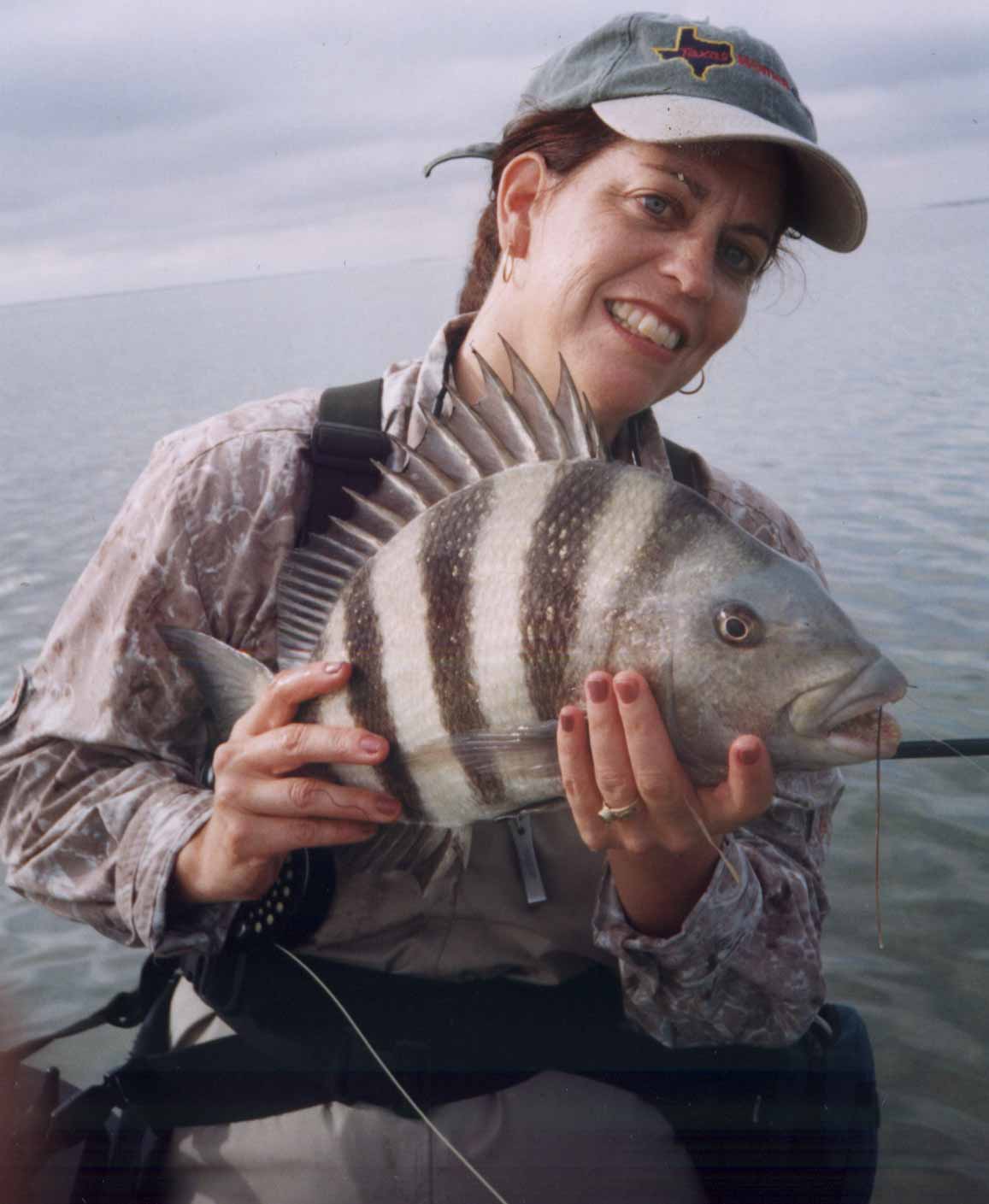 however,
the water may briefly cloud up, but only in those areas that have a softer,
silted bottom.
however,
the water may briefly cloud up, but only in those areas that have a softer,
silted bottom.
The winter
months offer an unusual bonus for the visiting fly fisherman: Big sheepshead
that normally refuse all offerings during the warmer months become surprisingly
willing to take a fly. Usually considered impossible to catch by fly fishers
who fish only during the summer season, winter sheepshead will sometimes
come from five feet away to snatch your fly. If you have never fished during
the winter time, you may find this hard to believe. But consider that on
one warm Sunday last February, Kathy and I hooked five sheepshead, and
landed two fish that were over four pounds apiece.
The Sticking Point
Of course, there's
always a catch in such idyllic fishing scenarios. In the case of winter
fly fishing on the lower Laguna Madre, the sticking point is the intermittent
cold fronts, along with their falling temperatures and blustery north
winds. The good news is that during an average winter, we may have a week
or more of summer-like weather between cold fronts, and once a cold front
hits, optimum fishing conditions usually return within two to three days.
But what happens if you hit it wrong? Traveling 1000 miles, and taking
a few precious days off work, only to land in the middle of 30-mph north
winds and murky waters, is a scenario that would give most fly fishers
a severe bout of clinical depression.
Fortunately,
modern weather forecasting can usually alert you and your guide to deteriorating
weather conditions before you leave home; and further, most of the guides
in this area are quite willing to reschedule their clients on short notice
due to abrupt weather changes. Indeed, traveling fly fishers will usually
find lower Laguna guides motivated to work with them around unforeseen
weather reversals, as long as there is an agreement to reschedule a trip,
rather than to cancel it altogether.
To do this right,
of course, you need to be somewhat in control of your own schedule, and
able to change plans without risking dire social and job-related consequences.
If you can negotiate these hurdles, then the only remaining obstacle is
the problem of changing flight plans without incurring expensive penalties.
Fortunately, Southwest Airlines observes a flexible rescheduling
policy, allowing you to cancel your flight, and take a credit toward a
future purchase. Of course, if you purchase an inexpensive ticket weeks
in advance of your planned travel, and then turn around and book a new
flight less than one week later, you will probably pay more for the second
ticket. It's not a perfect solution, but it works quite well if your new
reservations qualifies for Southwest's week-in-advance discounts. Also,
Southwest frequently offers deeply discounted fares, and will notify you
of these specials via e-mail if you contact them via their website at www.southwest.com.
The lower
Laguna Madre offers a vast, world-class fly fishing venue for those willing
to venture southward during the colder months. It’s unpressured,
it’s relatively inexpensive to reach by domestic travel, people speak your
language, and the fish are usually quite willing to take a fly. Hundreds
of square miles of foot-deep water, daytime high temperatures averaging
in the 70s, and sight casting in gin-clear water, add up to making the
lower Laguna an attractive winter fly fishing opportunity.
And like
many of the most precious things in life, it’s just "down the road and
across the bridge."