Trout to Take Your Fly
an unedited article that appeared in the
Spring 2002 issue of Fish and Fly Magazine
by Capt. Scott Sparrow
The
opening
between the spoil islands called Benny's Pass on the lower Laguna Madre
of South Texas is one of those places where the current runs faster
than
it does in surrounding areas. During an outgoing tide, in particular,
big
speckled trout will gather near the opening in search of a meal, and
their
dark protruding backs and tails can often be seen moving slowly and
deliberately
amid the nervous, flickering mullet.
My
friend
Jaime Lopez and I were scouting the area on the day before the 62nd
Annual
Texas International Fishing Tournament, hoping to locate the trout that
would clinch the fly fishing division for one of us. Neither of
us
had ever fished the tournament, and were not naturally inclined to do
such
things, but we had decided at the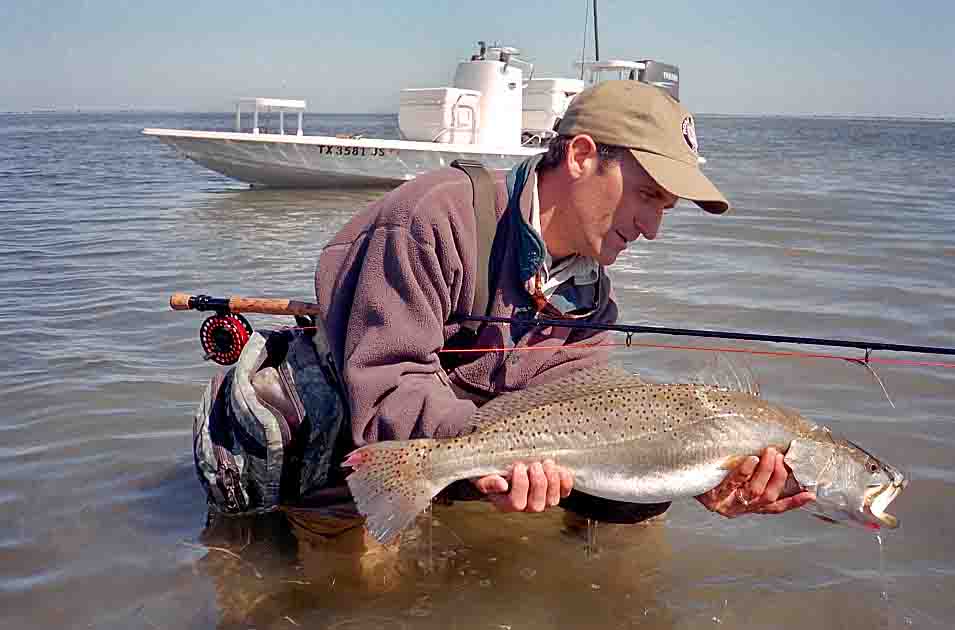 last minute to give it a shot,
nonetheless. Jaime was a hundred yards to the south, fishing from his
kayak,
while I stood with my five-weight with Benny's Pass to my back, casting
a tiny popper over the edge of the Intercoastal channel and stripping
it
back onto the shallow, clear flat.
last minute to give it a shot,
nonetheless. Jaime was a hundred yards to the south, fishing from his
kayak,
while I stood with my five-weight with Benny's Pass to my back, casting
a tiny popper over the edge of the Intercoastal channel and stripping
it
back onto the shallow, clear flat.
As I
relished
the warmth of the rising sun, I recalled a dream of the night before in
which my high school band director, Avie Teltschik, reminded me of how
important it was not to peak before a performance. Remembering how he
had
been a master of timing, and had won the coveted Texas Bandmaster Award
before he died, I thought, "I'd better not catch the big one too soon."
Minutes
later, I reached up in the middle of retrieving my fly to clean my
sunglasses.
The trout hit the fly with an explosion that spoke of her size and her
intent, leaving a foamy crater where my fly had just been. I fumbled
with
my rod and missed her just like so many other huge trout that have
exploited
my inattentiveness. I regained my composure, and seconds later, she hit
again. This time, I set the hook in time and felt her heavy body lunge
toward the deeper water. But then momentarily, she turned, and came
toward
me, and I saw her -- an eight- to nine-pound trout at my feet. We
eyed each other briefly before she turned and ran, eventually throwing
the fly after a spirited fight. Rather than cursing my luck, I thought
that at least I had followed Mr Teltschik's advice.
The next
morning just after sunrise, I returned to that very spot and caught a
trout
that ensured my win of the TIFT Fly Division.
Catskill
legend Edward R. Hewitt once said, "First a man tries to catch the most
fish, then the largest fish, and finally the most difficult
fish."
It is hard to say what accounts for this change of heart -- whether
it’s
an accumulation of successes, or failures, or the right amount of each
-- that takes us beyond crude quantitative measures of success.
But
when the change comes, then certain fish that have lurked vaguely on
the
edges of the imagination suddenly come into focus. That’s what happened
to me five years ago when the idea of catching big speckled trout
became
a consuming passion.
Even
without
a mid-life crisis to bring this dream to life, the quest for giant
trout
would have happened sooner or later, for the seeds of obsession were
implanted
at an early age by a father who always regarded them with a special
reverence
and awe. Even today at 82, Dad imagines hearing a trout in every noisy
swirl of a mullet's tail, and seeing one in every clump of floating
grass.
For years, my brother and I would groan inwardly at my father’s
fantasies.
But somewhere along the way, I began to see the world as he did, and
then
the only things that really mattered were few in number and beyond my
reach
-- like difficult fish and God.
In
fisheries
where survival depends on more than sheer luck, the most
difficult
fish to catch are also the biggest ones. When it comes to
speckled
trout in the lower Laguna Madre -- a subtropical, usually clear,
foot-deep
estuary that covers about 400 square miles at high tide -- this is
undoubtedly
true. For there, solitary trout spend much of their lives roaming
shallow
flats where they remain visible to herons, cormorants and other birds
who
would gladly relieve them of a pound of flesh. Clearly, something
besides
luck keeps them from harm for the eight or more years that it takes for
them to grow beyond 28 inches. And that 'something" is what makes
trophy
speckled trout 'difficult" -- that is to say, one of the greatest
challenges
in fly fishing.
The
Spotted
Seatrout, or
cynoscion nebulosis ("starry nebulae"), is a member
of the croaker family, and like its cousins -- the red drum, the black
drum, and the croaker -- "speckled' trout range from the
Chesapeake
Bay to the west  coast
of the Gulf of Mexico. Before they reach the spawning age of two
years, and a length of about 16 inches, trout feed on shrimp and tiny
glass
minnows and, while feeding, will attack just about anything remotely
similar
to the real thing that you toss in their direction. Indeed, small
topwater
and subsurface flies will draw as many as a half dozen slashing strikes
on a single retrieve through a school of feeding trout.
coast
of the Gulf of Mexico. Before they reach the spawning age of two
years, and a length of about 16 inches, trout feed on shrimp and tiny
glass
minnows and, while feeding, will attack just about anything remotely
similar
to the real thing that you toss in their direction. Indeed, small
topwater
and subsurface flies will draw as many as a half dozen slashing strikes
on a single retrieve through a school of feeding trout.
Once
they
mature, they break free of the schools, and roam the shallow flats in
search
of larger prey, such as mullet and pigfish. The males stop growing
after
a length of about 19 inches, but the females continue growing
throughout
their lives. These mature predators travel alone or in a pack with
other
large trout or redfish, and feed actively for only two hours out of
every
day.
Most of
the largest speckled trout taken on a fly rod are caught on the east
coast
of Florida or on the Gulf Coast of deep south Texas. Four of the
current
IGFA world records -- the 2-pound, 4-pound, 6-pound, and 20-pound
tippet
records -- were caught in the lower Laguna Madre, an
out-of-the-way
fly fishery that is increasingly regarded as "world class."
Indeed,
the LLM is widely acknowledged as the only fishery in the world where
fly
fishers regularly sight cast to speckled trout over five pounds.
Locating
huge speckled trout is a large part of the battle, for their movements
are as arcane as any fish to be found. If you fish often enough,
you may eventually find yourself standing among dozens of trout from
five
to eight pounds, and you might think that they gather like this every
day.
Like Percival, who was told that the Grail Castle was simply "down the
road and across the bridge," you might think that the big ones will be
easy to find next time. But also like Percival, you will eventually
wonder
how you could have been so silly.
Big
trout
usually show up when I'm least expecting them. Take, for instance last
August. I had just met Fred Arbona, founder of Climax and author. We
quickly
discovered that we held similar sentiments about the lower Laguna
Madre,
believing that it was somehow different, and more precious, than other
places we’d fished. And so, three days later, we went out fishing
together
for the first time, along with two of his buddies from Prescott,
Arizona.
Even though Fred had fished the upper part of the estuary for over 15
years,
he hadn’t explored the central LLM, where I did most of my fishing. So,
I offered to show him some of my favorite places.
I took
Fred and his friends to a small lagoon that most fishermen
overlook.
I parked some distance away from the mouth of the lagoon, and led the
men
overland through the marsh and the mangroves. Having caught ten redfish
there on my fly rod just two days before, I fully expected to be
greeted
by the sight of bronze-colored tails and backs. I was looking forward
to
the guys' reaction to this. But the reds that often lined the shoreline
of the moon-shaped lagoon were nowhere to be seen.
Still,
we waded out into the shallow water and began to blind cast. The wind
was
dead calm, and the surface remained unbroken, except for an occasional
leaping mullet. Just before I was ready to call it quits and move on, I
saw something that made my heart race -- the black tip of a tail 75
yards
away, near the center of the lagoon.
"Fred,"
I yelled. "Do you see that tail?"
"Yes,"
he said. "And there’s several more over here."
I moved
slowly toward the center of the lagoon, and began to notice a half
dozen
of large black tails breaking the surface film.
Just at
that moment, Fred shouted. His rod was bent, and a big fish was
erupting
at the end of his line. But a second later, his bent rod abruptly
straightened.
"She
broke
off!" He yelled. Fred had been using 8-pound tippet, which I
consider
much too light for my tastes. Most fly fishermen I know use 10 to 12-lb
tippet for this reason. But after catching over 350 tarpon on a fly
rod,
Fred has come to a place where the challenge matters much more than
success,
and relating to the fish matters much more than catching them. Indeed,
he recently told me about fishing years before with Lefty Kreh on the
Henry's
Fork. Lefty hooked a huge trout, and just stood there letting the big
fish
run. "Isn't this great?" he asked Fred.
Fred,
being much younger then, replied impatiently, "Aren’t you going to land
it?" At that moment, Fred reached reflexively for the rod to help the
master
fisherman close the deal.
But
Lefty
pulled the rod away, and lifted the rod abruptly, breaking the tippet
with
obvious intent. Teaching Fred a lesson that he would never
forget,
Lefty said, "You don't have to touch a fish to have a lot of fun."
The
quest
for large trout represents a three-fold challenge: finding them,
enticing
them to strike, and landing them. As for the first part, it takes years
of on-the-water experience to discern the movements of gamefish in a
fishery
that is truly daunting in its vastness. Indeed, I have fished the
Bay all of my life, and there are still many places that I've only
heard
about. As for the last part, landing big trout takes a prodigious
amount
of luck mixed with a smidgeon of finesse: Most of us lose five out of
six
of the big trout that we hook. While these factors are largely
out
of your control, you can still greatly improve your chances for
catching
trophy fish by concentrating on the middle part of the challenge -- by
understanding how to get them to take your fly.
I asked
my friend and fellow guide, Skipper Ray, who is widely acknowledged as
one of the best fly fishers on the LLM, "What is the secret to getting
big trout to take your fly?" In his usual laconic style, Skipper
replied,
"See the fish before she sees you!" -- as if this should be the most
obvious
thing in the world. But it isn't always the first thing that fly
fishers
consider. Nor is it easy to accomplish once you’ve embraced it as your
first order of business.
Before
you can see a big trout before she sees you, you must first realize
that
trout have an uncanny ability to sense your presence. A fly
fisher,
believing that a trout has not seen him, will often express surprise
when
the fish flees so quickly and decisively from his first presentation.
He
will typically attribute the fish's behavior to a lack of hunger or to
its species-inherent "spookiness." Or he will blame the fly. Such
time-honored mental maneuvers do nothing more than prove the axiom that
one's paradigm is always confirmed by operating according to its
limitations.
Actually,
a trout's lack of interest usually stems from having already
sensed
the fisherman's presence. Indeed, more often than not, the fish is
already
in a state of mild alarm before the fly fisher ever makes his first
cast.
Sparse Grey Hackle once asserted, "The real expert is always willing to
credit the fish with the inordinate wariness which it always manifests,
and he is willing to take the trouble to stalk as he should." Based on
this assessment, it's up to us -- not the fish or the fly -- to turn
our
failures into successes.
Cold
water
fly fishers know that stream trout will eventually get used to your
presence,
and resume feeding after a few minutes. Big specks will reward you
similarly
if you give them time to adjust to your intrusion. Taking time to enjoy
the beauty of what’s around you, to give thanks for the day,
or
to replace a knotted tippet, can make all the difference between
offending your hosts, and going unnoticed.
Just
yesterday,
for instance, Kathy, Fred and I went out in search of big trout on the
crystal clear flats of the east side of the LLM. With Fred wading to my
left and Kathy to my right, I spotted three big trout passing between
Fred
and me. I yelled to Fred, and pointed, and he spotted them, too.
Unfortunately,
they quickly moved upwind and out of reach in the 20-mph wind. Two of
the
fish disappeared, but one of them -- a hefty fish -- came to a halt
just
50 feet from me. Rather than continuing my downwind wade, I edged ever
so slowly toward her while she faced upwind, and then I stopped about
30
feet away from her. My slate-colored Aqua Design shirt closely
approximated
the shade of a Blue Heron's plumage, and I moved slowly and
deliberately
every once in a while as a hunting heron would do. Meanwhile, the trout
turned toward me, and milled around, obviously becoming aware of
my presence. With my hands to my sides, I glanced at her every once in
a while to ascertain that she was still there. Meanwhile, I stripped
out
about 30 feet of line, preparing to make a back-hand cast to her if she
should move across and downwind from me. Almost 15 minutes passed
before
she moved into range of a cross-wind, back-hand cast. Not willing to
press
my luck any longer, I false cast only once, and dropped the Mother’s
Day
fly about two feet from her. Without hesitation, she rushed toward the
fly, and took it before it had sunk more than a couple of inches. Taken
off guard, I stripped desperately to remove the slack, but felt her
only
briefly before the fly came loose.
Obviously,
my willingness to blend into her world had convinced the big trout that
I was no threat.
Even if a
trout
seems to adjust to your presence, she will still react instantly to any
unnatural movement that you make. Tom Kilgore, who holds the IGFA
4-pound-test
speckled trout world record, says that he casts as much as possible
with
his arms close to his body to minimize aggressive-appearing behaviors.
Further, he will not look directly at a big trout once he spots her, so
as not to alarm her. Fred supports Kilgore's tactics by
repeatedly
emphasizing that one must "walk like a heron" to approach these wary
gamefish.
To the uninitiated, this may sound like superstition. But by adopting
such
subtle tactics, Kilgore and Arbona regularly encounter opportunities,
and
achieve successes, that few fly fishers ever dream of.
Let's
look at some basic guidelines for achieving maximum stealth.
Maintain
a low profile.
It is rare for a fly fisher to catch a big trout
from aboard a boat. Trophyspecks
rarely stick around for high-profile intruders, and a boat is the
gravest
offender. If my clients ever express a preference for catching big
trout,
I tell them that the first thing they must do is to get off the
boat.
And then I advise them to crouch as low as possible -- even to
the
point of getting on their knees in the water --whenever they spot an approaching
trout.
they spot an approaching
trout.
Kayaking is becoming the
method of choice for fly fishers stalking big trout on the lower Laguna
Madre. My wife Kathy and I often strap our kayaks to our skiff, and
carry
them to areas where big trout can be found. In a foot of water,
you
can ride "side saddle" by putting both of your legs off on one side,
and
then scoot along with your feet on the bottom. You will be surprised by
how close you can get to feeding trout this way. Of course, it takes a
while before you get used to coordinating your fly rod, paddle, line,
and
anchor, but it only takes a trip or two to get it all together.
Wear clothes that blend
in.
You would do well to "dress down" for the encounter with a big
trout.
I now wear Aqua Design shirts after discovering that I can get a lot
closer
to the fish than when I wear brighter, or monochromatic clothes. Other
manufacturers seem to be following the new trend toward aquatic
camouflage,
so it’s no longer difficult to equip yourself with clothing that
matches
your environment.
Go
slow, and then go slower. Big trout are difficult to spot,
especially
on a dark, grassy bottom. Unless we stop and study the water carefully,
we will spook most of the fish before we see them. It's good to
remember
that the fish are almost always on the move, and that we don’t have to
"catch up" with them or to create opportunities that aren’t there: We
just
have to wait for the fish to appear. By wading very slowly, and
remaining
stationery for long periods of time, we will see more trout
approaching
us, giving us excellent opportunities for making effective
presentations.
Blind cast only when you
can't see anything. Many fly fishers cast continuously,
hoping
to strike it rich by accident. Unfortunately, by doing so they
"line"
the water between themselves and the farthest reach of their
cast,
creating a dead space all around them. It's better to hold off on
casting until you see something swirl or break the surface. If nothing
appears, then you might opt to make short casts all around you, taking
care to leave some undisturbed water within easy reach, so you’ll be
able
to cast to a fish that suddenly shows herself.
Take
breaks to study the water. Careful observation will teach you to
recognize
the subtle indications of a big trout's movements, but it’s hard to
study
the water with sufficient concentration if you are moving and
casting.
So stop frequently and look at the water very carefully. Learning to
see
the "lifeless" tip of a trout’s tail above the surface, or the
snake-like
movement of its dorsal fin amid a school of mullet, will make the
difference
between catching big trout and never seeing them. If you're lucky
enough
to have a friend or guide alongside you, who already knows how to spot
a tailing trout, it will greatly accelerate your learning process.
I was
32 before I saw my first tailing trout. They had been there all along,
but I had never seen them. As Thomas Kuhn said in his seminal work, The
Structure of Scientific Revolution, our paradigms determine
how
we perceive the world, and when paradigms change, then the world
changes
with them.
One memorable morning
twenty
years ago, my brother Chip took me to Benny's Pass and brought his boat
off plane in the middle of the deepest part, which was about 18 inches
deep. He’d seen tailing trout, and he’d brought me here to point them
out.
We stood on the front of the boat and peered out over the flat.
Suddenly
Chip said,
"There's
one! See it?" He pointed to a spot about 40 yards away.
I saw
nothing but a leaf. "I only see some trash," I replied.
"No,
that's
not trash, it's a tail. Now watch!" He insisted.
A moment
later, the "black leaf" disappeared, and then resurfaced a foot away. I
was stunned. It was alive! Having seen this happen for the first
time, I began to study the water with a "paradigm" that admitted
tailing
trout into the acceptable range of visible phenomena.
Once you spot a trout tailing or cruising, you need to be ready to cast to it immediately with a minimum of false casting. The trout will soon be on her way, and you’ll soon lose sight of her. To remain poised for action, Kathy and I use a stripping basket called the "Strip'n Aid" whenever we fish the flats. It’s a casting "basket" that amounts to only a black plastic platform with large upright teeth on it. Everyone I know who has used one for any length of time, including Fred, swears by its effectiveness. Equipped with this simple innovation, or a standard stripping basket for that matter, you can stand poised to make an 70-foot cast, or to flip your fly a few feet in front of you. By keeping your fly line coiled on the Strip'n Aid, and then using a very stealthy approach, you can take time to study the water, and yet remain ready for a quick presentation.
Flies and Tactics for Trophy Trout
Presentation
is just about everything when it comes to catching trophy speckled
trout.
I encourage fly fishers to refrain from blaming the fly for a
"rejection"
until they subtract out all other factors. Indeed, we would do well to
remember another statement by Ed Hewitt, in which he said, "Your fly is
all right; the trouble is on the other end of the rod."
Of
course,
it’s always true that the right fly can improve our chances. But what
makes
it "right"? You will find that the LLM fly fishers who regularly fish
for
trophy trout swear by flies that are highly idiosyncratic and wildly
diverse
in color and appearance. In trying to make sense of all of this, I have
finally concluded that the trout don’t much care what a fly looks like,
but they do care about how it behaves. Having said that, let's look at
some factors that might make a fly "right" for big trout.
Large
trout readily take both topwater and subsurface flies of various
descriptions,
but in the early morning, most fly fishers opt for topwater
flies.
Some fly fishers prefer large, tightly stacked deer hair flies,
while
I prefer smaller poppers comprised of a mixture of a
closed-cell
foam and deer hair -- a design that I call the VIP, for "vastly
improved
popper."
During the spring spawning
season from March until June, big topwater flies will often provoke a
territorial
response even if the trout are not very hungry. Later in the season,
however,
when hunger and opportunism overshadow the territorial
aggression
of the spawning urge, smaller and quieter flies seem to work better.
Use
topwater flies early.
I like to leave the dock well before sunrise,
because the best time for catching big trout "easily" is while the sun
is low. Whether the trout are actively feeding or not, they do seem to
hit flies more readily near sunrise than later in the day.
While the light is still
too low to see much, I make short casts in all directions, and greatly
vary the speed of my retrieve. Unlike redfish that prefer a moving
target,
speckled trout behave more like largemouth bass, and will hit your fly
after it's been stationery for some time. So it’s good to let it sit
for
several seconds in between strips, and then just give the fly a twitch.
These are the moments when the big ones often strike.
Learn
where to put the fly. As for positioning the fly, I try to cast
the
topwater fly about a foot in front of the trout's head. Big
trout are reflex strikers whenever something is "in their face." While
they may spook from the intrusion, they will just as likely attack the
fly without hesitation, especially if the fly enters the sight window
without
making a loud noise. If you cast farther away from the fish -- in an
attempt
to keep from spooking her -- she might come over and take the
fly,
but often she'll just follow the fly without ever striking it. If this
happens, you can often draw a strike by casting again, but this time,
putting
the fly a foot away from her. A big trout will often hit the same fly
that
she only studied with indifference a moment before -- if she doesn’t
have
time to think about it.
It
almost
never works to cast a topwater -- or subsurface fly, for that matter
--
beyond a big trout and hope that she will hit the fly as it crosses her
path. These predators are used to having to work for their meals, and
don’t
take well to the sight of a tiny baitfish hastening to its death. Try
to
present the fly on your side of the fish, so that as you begin to
strip,
the fly will appear to flee from the trout. If you misjudge the
distance
and cast beyond the fish's path, leave the fly where it is until you
can
reposition it. She'll swim under the line and you'll get another chance.
Use
topwaters over "potholes." Trout tend to lie up in open areas
called potholes. These are small openings in a grass-covered bottom
that
tend to be a bit deeper and lighter than the surrounding area. While
you
can easily spot a pothole with polarized sunglasses from some  distance
away, it is often hard to see a trout lying up in one, even if you’re
only
a few feet away. So it's a good practice to imagine that each
pothole
harbors a big trout, and then to put your topwater fly smack over the
middle
of it. Subsurface patterns work well over potholes, too, and are
usually
superior as the day progresses.
distance
away, it is often hard to see a trout lying up in one, even if you’re
only
a few feet away. So it's a good practice to imagine that each
pothole
harbors a big trout, and then to put your topwater fly smack over the
middle
of it. Subsurface patterns work well over potholes, too, and are
usually
superior as the day progresses.
Use subsurface patterns
that
undulate. I am a big proponent for legging and tailing
material
that moves while the fly is at rest. Some situations call for letting
your
fly sink passively and just sit on the bottom, and it's important for
the
fly to continue to look alive. Skipper Ray relies on a piece of rabbit
strip behind a red and white Seaducer to impart this lifelike
movement.
For myself, I use Dupont Lumaflex, sold under various names, on my
Mother's
Day Fly. This material works so well to convey lifelike movement
that I am sometimes rewarded by trout and reds picking it up off the
bottom
when it’s just sitting there. Bud Rowland -- who has probably
caught
more big trout on a fly rod than any person alive, and who just broke
the
IGFA 6-pound tippet world record -- uses a similar rubbery material on
his subsurface "Numero Uno" fly, and swears by its effectiveness in
provoking
strikes even when the trout are not hungry. Indeed, he caught his new
4-lb.
tippet world record -- a 10 lb, 2-ounce trout -- on the tiny,
undulating
"Numero Uno."
Not only
will a fly that moves at rest work better in general, but it can make
make
the difference between success and failure in the most difficult of
scenarios:
when a trout is "asleep." A trophy speck often go into an
unresponsive
state between active feeding periods. Her tail may be even be
slightly
out of the water during these naps, but no matter how many times you
rake
your fly across her back, she won’t strike it. In fact, you
can usually touch a sleeping trout with your rod tip before she will
respond.
By
giving
their flies perpetual movement, both Skipper and Bud make it possible
to
catch big trout even when the fish are in this unresponsive state.
Skipper
says that he lets his rabbit strip Seaducer sink to where it rests just
inches from the sleeping trout's head. He leaves it there until
he
sees the trout move. At that moment, he twitches the fly and often
draws
a strike. Bud, on the other hand, will cast his "Numero Uno" fly and
strip
it slowly past the sleeping trout again and again, until the trout
wakes
up. This, too, often draws strikes in a situation where most fly
fishers
simply throw up their hands and move on.
Use
a popper-dropper combo. Over the past five years, I have been
developing
what I consider to be the ideal popper and the ideal subsurface fly for
trout, but I have only recently combined them into a two-fly system
that
is amazingly effective.
This
past
February, Kathy and I went out to fish for a couple of hours just
before sunset. We took a spin out into the glassy east flats of the
lower
Laguna Madre. Mullet were boiling everywhere, and so we suspected
that game fish were among them. As we planed over eight inches of
water,
redfish and trout suddenly scattered in all directions. I abruptly
stopped
the boat, and Kathy and I were in the water in minutes.
As we
moved slowly away from the boat, it became clear that the ubiquitous
sheepshead
were the only game fish showing themselves in the dead calm conditions.
So we resorted to casting blindly, hoping to connect with the big reds
and trout that we knew were there. However, we spooked fish with almost
every cast, and could not seem to get them to see our flies in the
diminishing
daylight.
After
fishing fruitlessly for almost an hour, I recalled that I'd tied some
VIP
poppers with a trailing Mother's Day Fly. So I tied on the combo and
began
blind casting as delicately as possible. Within a few minutes, a big
trout
bulged under the popper and came out of the water, hooked momentarily
on
the shrimp pattern. Kathy, who was nearby, heard the commotion, and
wasted
no time in asking, "Hey, do you have another one of those?" Fortunately
for me, I did.
Within
minutes she’d hooked a nice red on the rear fly. As I was cheering her
success, a 24-inch trout noisily struck my popper. Anyone down here
knows
that you will miss about 80 percent of the trout that hit a topwater
fly,
so I wasn't surprised when the fish wasn’t there when I went to set the
hook. But suddenly, the fish lunged forward and ate the back fly as a
consolation!
Minutes later, I released the beautiful fish and took two reds
over
24 inches on the dropper fly before the setting sun brought an end to
our
excitement.
Combining
two flies in a tandem rig that casts without fouling is a daunting
task,
but the popper-dropper combination comprises a two-course meal that may
easily double your hook-ups.
Sight casting to trophy speckled trout is about as challenging as it gets. It appeals to those who have caught the most and the biggest fish, but now want to catch the most difficult ones. After spending many years pursuing this wary predator with a fly rod, all I can honestly say is ... that they're not quite as difficult as they used to be.