The Dance of the Gulls:
Fishing for Podding Redfish
by Scott Sparrow
Fishing for Podding Redfish
by Scott Sparrow
The sound of laughing gulls roused me from a fitful sleep aboard the unforgiving deck of the Curlew. The blinding brightness of the April full moon had given way to a fog that enveloped the boat. I reached for the thermos, and sat up in my sleeping bag to sip my lukewarm coffee.
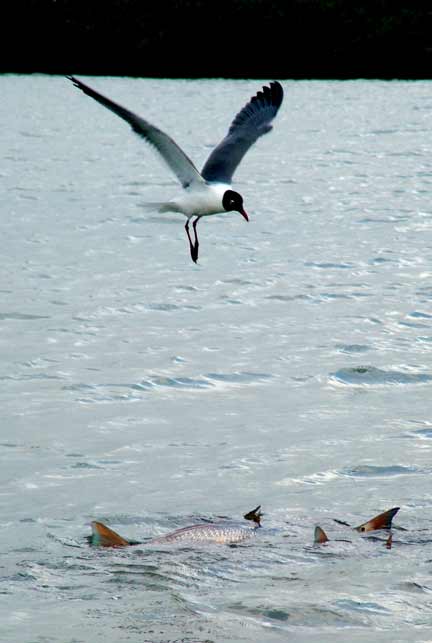 “They’re here,” I thought, as I listened
to the sound of the gulls through the gray mist. The erratic,
competitive cries told me that the birds were feeding over redfish that
were gathering somewhere between the Curlew and the mangrove-covered
shoreline.
“They’re here,” I thought, as I listened
to the sound of the gulls through the gray mist. The erratic,
competitive cries told me that the birds were feeding over redfish that
were gathering somewhere between the Curlew and the mangrove-covered
shoreline. The day before I’d brought an old client -- Jim Posgate from Kerrville -- into this westside lagoon on the Lower Laguna Madre. The wind had been calm, and the laughing gulls had struggled to stay aloft over the tailing fish. Many of them had simply given up flying, and had swum around amid the tails, trying to grab the shrimp that were hopping across the surface. Jim had followed several pods of redfish around the inlet for over two hours, and had handily caught and released seven fish with his fly rod.
This morning, however, I was alone, and my fly rod was stored beneath the deck. I was interested only in watching and photographing the melee of birds and tailing fish that were gathering once again in this remote lagoon. As the sun turned the fog from gray to white, I could finally make out the birds hovering above the water only 50 yards away. And then, gradually. I could see the blue-tinged tails of redfish beneath the gulls. Slipping into the water with my SLR on a tripod, and my digital hanging around my neck, I prayed for steady footing on the mucky bottom, and set off toward the party, hoping to partake in the festivities without offending my hosts.
The Cycle of Podding Action
The cycle of podding activity is a complex and species-interrelated phenomenon, tied in particular to the movement of shrimp in and out of the back lagoons -- or “tertiary” bays of the Lower Laguna Madre.
When the tides rise in the early spring, redfish move into the back lagoons where they feed in pods on brown shrimp while the waters are high and cool. As summer approaches, the larger shrimp migrate toward the deeper waters of the Intracoastal Waterway, and eventually move into the open Gulf where they spawn. The onset of summer brings a lowering of the tides, and a gradual warming of the bay water, making the back lagoons less attractive to shrimp and redfish alike, except during cool mornings or especially high tides. Podding action continues through the summer, but it’s more subdued and less likely to attract the attention of the laughing gulls. With the rising and cooling waters of autumn, the redfish -- and the attendant laughing gulls --return to the tertiary bays to feed principally on juvenile white shrimp, which are preparing to make their spawning exodus to the open Gulf.
The best and worst of times. Podding action can turn an otherwise dismal day of sight casting into a veritable bonanza, especially during the “worst” sight casting months of the year -- March and April -- when incessant southeast winds and murky water make it nearly impossible to spot fish. Indeed, when the wind blows the hardest, the laughing gulls can remain aloft over podding redfish with relative ease; and so rather than heading inland for easy pickings in freshly plowed fields and city dumps, many of them will stay on the bay, and use the wind to their advantage. Visible from a mile away, a flock of laughing gulls working low to the water almost always indicates the presence of tailing pods of redfish.
The Keys to Success
Upon encountering this feeding frenzy for the first time, a visiting angler may think that catching a redfish from a pod is as easy as walking up and dropping your fly or lure into the mass of feeding fish. After approaching countless pods as an angler and as a guide, I’ve discovered that the poet’s words, “’Tis many a slip twixt the cup and the lip,” are never more true than when sight casting to podding redfish. And yet, armed with adequate knowledge of the fish’s behavior while podding, an angler can turn an otherwise frustrating opportunity into easy fishing.
Knowing what to look for. Most experienced bay fishermen know how to interpret a flock of laughing gulls working low to the water, and they will race to the scene to take advantage of the situation. But in the absence of such obvious signs, it’s important to know what else you can look for.
I’ve found that a single gull in flight may reveal the presence of a pod of redfish. You would think that a group of feeding fish would
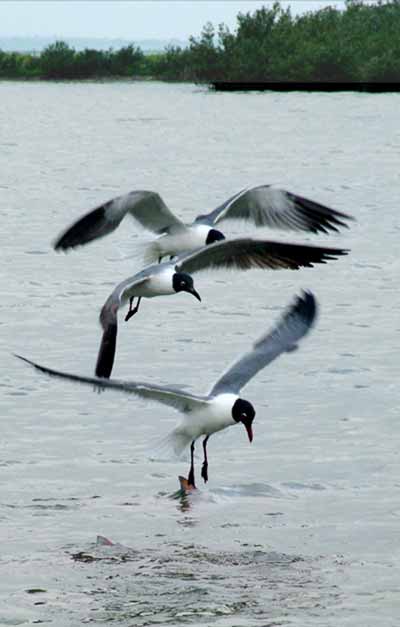 attract more than one bird, but sometimes
most of the gulls are feeding inland. When a gull is over fish, it will
behave in a distinctive manner. Rather than traveling, it will hover
over one spot. Then, it will drop to the water, and chase something
across the surface before returning to its waiting on position. If a
gull repeats this maneuver several times, you can be pretty sure
that it is feeding on shrimp that redfish are driving to the surface.
Once you learn to recognize “the dance,” you’ll be able to find podding
redfish with the help of only a single bird.
attract more than one bird, but sometimes
most of the gulls are feeding inland. When a gull is over fish, it will
behave in a distinctive manner. Rather than traveling, it will hover
over one spot. Then, it will drop to the water, and chase something
across the surface before returning to its waiting on position. If a
gull repeats this maneuver several times, you can be pretty sure
that it is feeding on shrimp that redfish are driving to the surface.
Once you learn to recognize “the dance,” you’ll be able to find podding
redfish with the help of only a single bird.On calmer days, you may not see any birds in flight at all. Laughing gulls may be sitting together on the water, and chasing shrimp across the surface from time to time. Whenever I’ve spotted gulls doing this, and taken the time to approach them quietly, I have almost always found that they were following a pod of tailing reds.
Terns can tell the truth. Terns are known as “liar birds” up and down the Texas coast, because they do not always indicate the presence of feeding fish. If they are spread out and diving, then it’s unlikely that they are feeding over podding reds. But if they dive over the same spot again and again, then they are often following a pod. Terns and gulls will compete for the shrimp, but the gulls have the advantage, because -- unlike the terns -- they can feed by hovering a foot above the water. Indeed, once the laughing gulls find the pod, they will usually monopolize the area around the tailing fish.
Carpe Diem -- within reason. At first sight, the spectacle of a group of tailing redfish can easily mesmerize an angler into thinking that he has all day to take advantage of the situation. But if you want to catch podding reds, you have to move fast, because as a rule, they won’t keep doing it for long.
Moving fast does not mean motoring up to the edge of the pod, and jumping noisily into the water. Redfish will typically stop podding if you power your boat within 100 yards of them, and on calmer days, you sometimes can’t get within 300 yards without putting them down. Once you spot the birds working, you should make a wide loop upwind, and shut down the motor at least 200 yards away. Then you can pole or drift toward them, and anchor when you get within 50 yards or so. Ask your buddies to get their rods ready, and then to put their feet over the gunwales before you get close, so they won’t make a lot a noise when they slip into the water.
The Illusion. As you wade downwind toward a tailing pod, the hovering gulls -- which are facing the wind -- will give the impression that the fish are headed your direction. This is sometimes true, of course, but not always. Redfish do seem to work upwind, perhaps
 because when the shrimp jump out of the water,
the wind blows them back toward the pursuing fish. But the fish
will often circle back downwind, and sweep upwind again and again in
the same general area. Because of the illusion created by the birds,
wading anglers may wait for the pod to approach, only to have them move
even further out of casting range.
because when the shrimp jump out of the water,
the wind blows them back toward the pursuing fish. But the fish
will often circle back downwind, and sweep upwind again and again in
the same general area. Because of the illusion created by the birds,
wading anglers may wait for the pod to approach, only to have them move
even further out of casting range. The Most Common Error. I’ve found that most of us, when approaching a tailing pod of redfish for the first time, will get excited and cast too soon. Spin fishers can afford to cast, and take up line as they continue wading. But fly fishers have to reign in their impulses if they ever intend to reach the fish. Limited to a 50- to 70-foot cast at best, they will often overestimate their abilities to reach the pod, and fall short of the mark again and again. Further, a fly fisher cannot effectively cast and strip the fly while wading forward: They have to stop moving to get any positive movement on the fly. Each time they stop to cast and retrieve the line, they give the pod time to move even further out of range.
A short cast may reap a reward, but usually a less desirable one. Small trout and ladyfish often encircle podding redfish, and will seize the lure or fly if they get a chance. I’ve seen trout up to 22 inches around the edges of podding redfish, but they are usually much smaller than that. And, if a ladyfish or trout should take your fly or lure, there is a very good possibility that the pod with “blow up” from the disruption, and never reassemble.
Redfish have a way of getting past you. If the pod is working upwind, it’s important never to let them pass you before you can reach them with your cast. That’s why I often coach my clients to slide sideways, rather than to approach the pod directly, in order to intercept its path. By walking directly toward the fish, or casting too soon without anticipating the direction of the pod’s movement, the angler may let the fish get crosswind -- and then upwind -- making an effective cast difficult, if not impossible, on a windy day.
Podding redfish can seem to be blind. Podding redfish will rarely see a lure or fly unless it’s inches from their heads. As they feed head down, they are only able to see what’s immediately in front of them. In addition to the restricted visibility, the noise of their own feeding frenzy -- paired with the birds’ raucous cries -- renders the podding fish less sensitive to everything around them. Getting no response, anglers will often conclude that the fish are not interested in their offering, and may waste precious time changing flies or lures unnecessarily. I often say to my clients: If a redfish doesn’t react, he hasn’t seen the fly yet. So cast again! I know this assertion provokes disbelief in many of my clients -- but only until they witness the unbridled zeal with which a podding redfish will seize a fly once sighted.
All for one and one for all. Podding redfish often “blow up” as soon as the first fish is hooked. That’s why it’s common to catch only
 one fish out of a pod. If there are two or more anglers, the one who
gets into casting range first can hold up and wait for his partners to
cast before making his presentation. Such courtesy can cement lasting
friendships, but it can also give the pod time to move on or to
disperse. As an alternative, anglers can cast to the edge of the
tails, hoping to pull a fish away without spooking the rest of the
group. For instance, I once saw a fly fisher catch eight redfish out of
a single pod without putting them down, simply by casting to the edge
of the action, and quickly pulling the fish away from the group.
one fish out of a pod. If there are two or more anglers, the one who
gets into casting range first can hold up and wait for his partners to
cast before making his presentation. Such courtesy can cement lasting
friendships, but it can also give the pod time to move on or to
disperse. As an alternative, anglers can cast to the edge of the
tails, hoping to pull a fish away without spooking the rest of the
group. For instance, I once saw a fly fisher catch eight redfish out of
a single pod without putting them down, simply by casting to the edge
of the action, and quickly pulling the fish away from the group.Flies and Lures to Use
If it’s not too windy, Kathy and I like to use VIP poppers or East Cut Poppers over tailing pods early in the day. You can cast a subsurface fly to a pod again and again without them
 seeing
it, but a small, noisy popper will imitate the sound and appearance of
a fleeing shrimp, and will usually bring the fish to the top.
seeing
it, but a small, noisy popper will imitate the sound and appearance of
a fleeing shrimp, and will usually bring the fish to the top.
On a windy day, the wave action may drown out the noise of the popper. In that case, we like to use a Mother’s Day shrimp pattern with some flash in it, or a Clouser Minnow. We use flies in darker colors if the water is off color, and slightly weighted flies if the water is deeper than 18 inches, given the fact that tailing reds have their heads near the bottom.
Just about any fly or lure will work as long as it acts naturally, and doesn’t attack the fish. Podding redfish are not selective even though they are feeding almost exclusively on shrimp, because they are in a highly competitive situation in which a moment’s hesitation becomes a forfeited meal. Consequently, podding reds tend to strike without hesitation. Slashing sideways as they are prone to do, these fish may not hook up as securely as when they have time to follow a fly or lure, and take it from behind.
But who’s complaining? Fishing for podding redfish is an exciting game, and the experience of seeing waving tails and skipping shrimp beneath crying gulls will leave its imprint upon you. One has the feeling of entering into a rich interplay of species whose lives are intertwined in a dance that is, at once , deadly serious and immensely beautiful.
Just to be there among them is usually enough for me.