The Texas Caribbean
Fishing the White Sand
of the Lower Laguna Madre
an unedited version that was
featured in
Fly Fishing in Salt Waters,
Sept-Oct 2002
by Capt. Scott Sparrow
On a Sunday afternoon in late
June, Fred Arbona, my wife Kathy and I waded with five fly fishers from
central Texas. The sky was cloudless and the wind held steady at
under 12 knots. It was one of those days on the lower Laguna Madre of deep
south Texas when it all comes together -- when, in Fred's words, it's "the
best there is." As we waded, packs of ladyfish shot through our ranks,
and redfish and speckled trout -- singly or in small groups -- came into
view one after another, often escorted by stingrays. As I watched the group
of fly fishers, spread out over several hundred yards, I could easily interpret
their stealthy movements: They were onto fish. The walkie talkies were
silent, for no one wanted to break the spell that had settled onto the
vast Caribbean-like flat known simply as the "white sand."
When I was a teenager growing
up in south Texas, my world revolved around fishing these pristine waters.
My Saturdays consisted of getting up early, working for my dad until about
noon, and then getting permission to take off for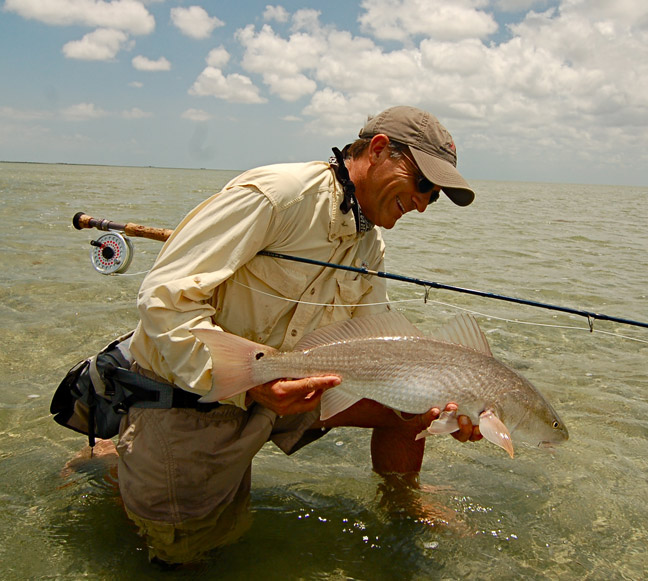 Padre Island, fifty miles to the east. I'd hastily change into cutoffs
and old sneakers, and load my single spinning rod into my dad's Scout.
And then I'd head for the Island just as fast as the aging Scout would
carry me, which was far slower than the law would allow.
Padre Island, fifty miles to the east. I'd hastily change into cutoffs
and old sneakers, and load my single spinning rod into my dad's Scout.
And then I'd head for the Island just as fast as the aging Scout would
carry me, which was far slower than the law would allow.
Crossing the causeway at
Port Isabel, I'd head up the Island on the single north-south road, eventually
leaving the pavement for the western shoreline. Faint 4x4 tracks provided
a myriad of options for continuing my journey up the longest barrier island
in the world. By the time I'd step foot into the warm water, I'd have only
a few hours to fish before the midsummer sun would fail me, and then I'd
have to head back home. Until then, I'd wade in a foot of crystal
clear water on hard sand, stalking redfish and speckled trout with light
spinning tackle. It was well worth the 100-mile trip.
While I taught myself to
fly fish when I was 12, I never considered fly fishing in the lower Laguna
until I was much older. After moving away from my home waters as
a young adult, it finally occurred to me that both redfish and trout would
surely take flies, so on a visit home back in the late 70s, I took my only
graphite fly rod down to the bay one foggy morning and promptly caught
two redfish on floating deer hair flies. Overwhelmed by the possibilities,
I put away my spin tackle and never looked back.
In 1999, on a leap of faith
that looks more rational as time passes, Kathy and I moved back to my home
waters and opened a fly fishing lodge on the lower Laguna. Having
fished the estuary all my life, I had never ventured beyond a few familiar
places, and so I felt initially unprepared to guide fly fishers on this
vast fishery. Equipped with an ultra-shallow skiff, and willing to listen
to those who knew the estuary better than I did, I traveled north
to little known hotspots above Port Mansfield, fished the ecologically
diverse South Bay near Port Isabel, and eventually became familiar with
just about everything in between. However, I temporarily overlooked the
vast sand flat where I had spent those sacred weekends of my youth.
I was not alone in my neglect
of this classic fly fishing venue. Even today, most spin and fly
fishermen still concentrate on the central and western side of the lower
Laguna where sea grass meadows provide abundant habitat for bay shrimp,
crabs and baitfish. Sight casting opportunities abound in these fertiles
waters, where the redfish are more likely to "tail" when feeding.
Approaching the white
sand by boat. As one travels by boat eastward toward Padre Island,
the depth decreases, and most of the vegetation eventually disappears.
Most fishermen turn back when they reach the transition between the grass
and the white sand, either because it's too shallow for their boats, or
because it seems devoid of life.
If they were to go further,
they'd reach a narrow "green belt" adjacent to the Padre Island shelf.
This fertile, grassy strip separates the sand from the western edge of
Padre Island, which is nonetheless often flooded at high tide.
In my first year of guiding,
I met Climax founder and fly fishing author Fred Arbona. After fly
fishing the Texas coast around Rockport and Corpus Christi for over a decade,
Fred eventually shifted his focus to the lower Laguna and its uniquely
clear and unpressured waters. As a widely traveled fly fisher, he immediately
grasped what made the lower Laguna special. It wasn't so much the Florida-like
sea grass meadows that appealed to most fishermen: It was the Caribbean-like
white sand. Indeed, one night just after we'd met, Fred declared
that stalking large redfish on the white sand was the most challenging
and rewarding fly fishing he'd ever encountered. Knowing that he'd caught
over 350 tarpon on a fly rod, and had guided on the Henry's Fork and other
premier coldwater streams in his youth, his statement got my attention.
 Shortly
afterward, we went out together and headed southeast from our lodge toward
the area where I'd fished as a teenager. As we came within a half mile
of the Padre Island shoreline, the grass played out, and we came to a flat
that seemed, at once, so familiar and so forgotten. The water sparkled
like a finely faceted gemstone, and the bottom revealed a continuous yellow-white
coloration marked by mere sprigs of seagrass. We made a big loop upwind
toward the Padre Island shoreline, cut the motor and began drifting back
across the flat, looking for evidence of cruising game fish.
Shortly
afterward, we went out together and headed southeast from our lodge toward
the area where I'd fished as a teenager. As we came within a half mile
of the Padre Island shoreline, the grass played out, and we came to a flat
that seemed, at once, so familiar and so forgotten. The water sparkled
like a finely faceted gemstone, and the bottom revealed a continuous yellow-white
coloration marked by mere sprigs of seagrass. We made a big loop upwind
toward the Padre Island shoreline, cut the motor and began drifting back
across the flat, looking for evidence of cruising game fish.
After spooking several reds
and trout that were prowling the shimmering water -- we anchored and began
wading. Within an hour, we'd cast to numerous reds and a few large trout
trout that were visible from over 150 feet away. Reflecting on my rediscovery
of the white sand, I realized that the most precious things in life are
often the things that we've left behind.
The lower Laguna is a virtually
landlocked, sixty-mile-long hypersaline lagoon surrounded by vast, undeveloped
acreage. Bordered on its east side by Padre Island National Seashore,
it is protected from development on its west side by Laguna Atascosa National
Wildlife Refuge, and by the King Ranch. Given the presence of these
guardians, there is virtually nothing unnatural to mar the austere mangrove-,
yucca- and cactus-lined shores of the lagoon.
Although the lower Laguna
is the only true subtropical fishery in the U.S. outside of Florida, the
main species of gamefish that inhabit its waters -- redfish and spotted
("speckled") seatrout -- are found throughout the Gulf and the Atlantic.
Two lesser gamefish species -- black drum and sheepshead -- inhabit the
estuary year-round, and offer formidable challenges for fly rodders on
the white sand. Several tropical species, such as tarpon, ladyfish,
jack crevalle and snook, can be found seasonally in the estuary, or in
the inshore waters around the two passes that join the lagoon to the open
Gulf.
Averaging five miles wide,
the lower Laguna encompasses about 300 square miles, but the white sand
represents less than 20% of the total area. Beginning as a narrow strip
of sand a few miles north of the town of South Padre Island, it widens
to over a mile wide in some places, depending on the tide.
What is the special appeal
of the white sand? While the water in the entire estuary is usually clear
-- which makes the lower Laguna remarkable in itself -- the white sand
has a firm, sandy bottom, making it easy to wade. Also, because the
flat contains virtually no vegetation, a fly fisher can see fish approaching
from as far away as 100 yards on a clear, sunny day. This highly visual
encounter can extend the excitement of stalking fish for several minutes,
as the fly fisher attempts to move into position for an effective presentation.
What brings the big fish onto the white sand. As a strategy for finding gamefish on the flats, most fishermen will search for the presence of schools of mullet. While this can be an excellent predictor, large numbers of redfish may show up on the white sand even when the baitfish are nowhere to be seen. The key to their behavior lies in food sources beneath the sand. In particular, there is a dark green worm called the lug worm, which burrows into the sand, leaving small openings for its head and tail. In addition, tiny crabs tap into the lugworm's burrow, using it as a source of seawater and nutrients while remaining invisible to predators. These subsurface organisms account for the presence of redfish in the middle of what appears to be a completely lifeless body of water.
The Superbowl of Sight
casting. Last year, I had the opportunity of guiding steelhead expert
Lani Waller on the sand. Accompanied by a cameraman who was filming footage
for the video, "Coastal Fly Fishing with Ken Hanley
and Friends," we poled the white sand near the shoreline of Padre Island
in search of visible redfish. We were blessed with ample opportunities,
but Lani had to cast again and again before his prodigious angling skills
prevailed. Finally, he hooked his first Texas redfish on a tiny VIP popper.
After releasing it, Lani declared with awe in his voice, "This is among
the most technically demanding and sophisticated fly fishing Iíve ever
encountered."
Not exactly an advertisement
for the traveling novice! But Lani was fishing from aboard a poled skiff,
which is undeniably the most difficult way to catch fish on the white sand.
The fish are cruising in less than a foot of clear, vegetation-free water,
with nothing to obscure their view of the approaching boat. Indeed, by
the time the poled fly fisher has come within casting range, the fish is
usually on alert and turning away.
Even when an expert fly caster
gets off the boat and approaches redfish and trout on foot, the skinny
clear water still makes it difficult to present the fly unobtrusively.
Bill Gammel -- member of the FFF Board of Governors and well-known casting
instructor -- said to me recently after presenting fruitlessly to several
reds, "This is the Superbowl!"
Fortunately, there are ways
to circumvent some of the difficulty.
Chinks in their armor.
Redfish and trout are more approachable when they are distracted by the
feeding opportunities on the white sand. Redfish, in particular, will often
approach with their heads down, as they root for worms and crabs. While
theyíre looking down, you can usually get a lot closer to them before they
see you.
In addition, both redfish
and trout will trail solitary stingrays, feeding off the morsels that the
ray flushes from the bottom. When this combo approaches, the cinnamon-colored,
platter-sized ray is much easier to see than the trailing game fish. By
concentrating on the area around the ray, a fly fisher can often spot a
fish that might otherwise go unnoticed.
Further, when traveling with
rays, game fish will usually come much closer to the fly fisher before
spooking. Since the trailing fish remains visually locked onto the back
of the ray, he tends to ignore his surroundings while remaining poised
to attack whatever pops into view. This confers a double advantage to the
fly fisher. Not only does the fish overlook the fly fisher, but the fish
will take a well-presented fly with less hesitation.
Last spring I was poling
a local fly fisher, Bill Ellis on the white sand. We'd seen dozens of redfish,
but he hadn't managed to catch one: Invariably, the fish would see the
boat before Bill could present the fly. At one point, I said, "What we
need is a redfish behind a stingray." Moments later, nature answered my
plea, and a stingray appeared with a redfish in tow. The fish followed
the ray dutifully until it was within 30 feet from the boat. Bill made
the necessary cast, and the redfish inhaled the fly on the drop.
Besides the stingray/gamefish
relationship on the white sand, there is another relationship that the
fly fisher can exploit. 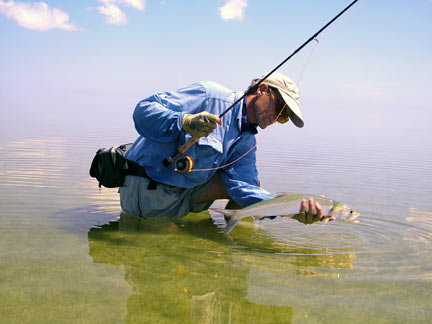 Packs
of ladyfish roam the sand from spring until fall. In addition to providing
great sport, they are usually easy to see coming, thus giving a fly fisher
time to present his fly without being noticed. Further, they often
harbor a hidden surprise -- one or more gamefish accompanying the school.
In this highly competitive context, redfish and trout are usually more
willing to seize a fly than when traveling alone.
Packs
of ladyfish roam the sand from spring until fall. In addition to providing
great sport, they are usually easy to see coming, thus giving a fly fisher
time to present his fly without being noticed. Further, they often
harbor a hidden surprise -- one or more gamefish accompanying the school.
In this highly competitive context, redfish and trout are usually more
willing to seize a fly than when traveling alone.
Unfortunately, given the
ladyfish's speed and aggression, it can usually beat a redfish or a trout
to the fly. For instance, a client of ours -- Peter Koga of Orange County,
California -- recently spotted a large redfish on the white sand, and made
a cast that drew an immediate strike. But not from the redfish! A ladyfish
hit the fly just as soon as Peter stripped.
Fortunately, my friend and
fellow guide Skipper Ray taught me that there is a way to circumvent the
ladyfish's zeal -- by stripping slowly. A ladyfish will sometimes take
the fly as soon as the fly hits the water, but once it has inspected the
fly, it usually won't take it if the fly is moving slowly. So, if a fly
fisher can present to the pack and strip slowly, a trailing gamefish will
often take the fly after the ladyfish have refused it.
Last summer, for instance,
I spotted a small school of ladyfish approaching rapidly from downwind.
Having already caught two, and lost a fly to one, I was hoping to hook
a game fish this time, so I decided to let them pass. But as they flashed
by me, I noticed that one fish stood out from the rest. Ladyfish have a
forked green tail, but this fish had a flat, dark tail -- the signature
of a speckled trout! I flipped my Mother's Day shrimp pattern to it as
it passed, stripped slowly, and the 24-inch trout took it without interference
from its mercurial companions.
Another way to fish selectively
for gamefish is to use a less flashy fly. Ladyfish will strike just about
any shiny fly, but will usually pass up flies comprised of unreflective
materials. Since I like to use flashy materials in my flies, Skipper's
slow stripping method lets me have my cake and eat it, too.
Wading is usually best.
Except for days when the tide is too high to see the fish while wading,
or times when the fish are too spread out to justify the effort, wading
is our preferred method for fishing the white sand. Fishing from a poled
skiff affords a view of the white sand that is so complete that it becomes
hard to accept a more limited vantage point. What fly fishers fail
to realize, however, is that many gamefish turn away before the fly
fisher can ever spot them. Not only can gamefish see a boat coming
from a long way off, but fleeing baitfish, ladyfish and sheepshead provide
an early warning system that alerts gamefish to our approach. This all
adds up to an apparent paradox that has become an article of faith among
white sand fly fishers: A wading fly fisher will see and catch more
game fish than a fly fisher aboard a poled skiff.
The fly fisher aboard a boat
enters into the natural order as a high-profile intruder, sending baitfish
scurrying in all directions. Largely invisible to the fly fisher because
of their diminutive size, fleeing baitfish can nonetheless disrupt the
feeding behavior of gamefish that are still out of sight. The gamefish,
in turn, will either join the fleeing fish in their exodus, or become more
vigilant than before. Instead of rooting happily in the sand, they may
assume a heads-up, cruising pattern that allows them more easily to spot
high-profile intruders. Since they're already on alert, these fish are
more likely to reject a fly or flee at the slightest intrusion. Consequently,
the poled fly fisher may conclude erroneously that the the fish are "spooky"
or "not eating."
In contrast, a wading fly
fisher can blend more easily into the natural order. Even the hyperactive
mullet will tolerate his presence if he proceeds in a patient, deliberate
fashion. Once the baitfish are convinced that the fly fisher poses no threat,
the gamefish may reward him similarly with their presence.
Presentation is just about
everything. I have not found redfish and speckled trout particularly
selective when they are roaming the white sand of the lower Laguna Madre.
If they are actively feeding, they will take just about anything that is  presented
impeccably. With this in mind, we do have our
favorites. When the fish seem spooky, Kathy and I use the Mother's
Day Fly or a Glassy-eyed Shrimp in drab colors. They work well on the sand,
probably because they resemble both shrimp and crabs in eye-catching configurations.
presented
impeccably. With this in mind, we do have our
favorites. When the fish seem spooky, Kathy and I use the Mother's
Day Fly or a Glassy-eyed Shrimp in drab colors. They work well on the sand,
probably because they resemble both shrimp and crabs in eye-catching configurations.
When the fish are feeding
more aggressively, we tend to use the same flies in flashier colors, or
Fred's favorite fly for the white sand -- a simple pearlescent mylar fly
-- principally because it's easy to see in the water. Knowing exactly where
your fly is can improve your ability to anticipate strikes.
We often use small topwaters
when the wind is low, just because the strikes are so exciting. Kathy
and I use my own VIP popper -- a marriage of foam
and spun deer hair that casts well in the wind.
Skipper Ray's lugworm imitation
can save the day when the reds are feeding selectively on lugworms. For
example, last fall Fred was fishing with two fellow guides on the white
sand north of Port Mansfield. None of the fly fishers could get the plentiful
redfish to eat. Remembering that Skipper had given him a lugworm imitation,
Fred tied on the homely pattern, and proceeded to hook six redfish in quick
succession by using a very slow, finger-over-finger retrieve.
The best times to fish the
white sand. Because the white sand is the shallowest part of the lagoon,
it fishes well during the spring and fall, when the seasonally high tides
bring an extra foot of water into the estuary. During this time, the tides
flood thousands of acres that are usually too shallow for boats and gamefish
alike. It is then that big reds, in particular, take advantage of the food
sources that have remained largely unavailable to them during the lowest
midsummer and midwinter tides -- that is, the resident lug worms and crabs.
During the highest tides, the fish may even move farther east onto the
"upper sand" -- a virtually untouched area that appears from the distance
as a shimmering mirage at the foot of the Padre Island dunes.
Periodically, gamefish move
onto the white sand during the summer and winter, as well. June through
early July is particularly good in areas adjacent to deeper water, such
as east of Three Islands (ICW Marker 41), east of The Saucer (ICW Marker
179), and south of the Mansfield cut spoil islands. The fish seem to gravitate
toward the shallower waters when the difference in water temperature becomes
attractive to them. Since the shallow water on the white sand changes more
rapidly in response to changing air temperatures, it often seems
to "lead the way" in sending fish fleeing as temperatures rise or fall
beyond tolerable levels -- as during a cold snap or a heat wave. Or, conversely,
the sand will draw them from the deeper water during a winter warming trend,
or after a cool summer night or rainstorm.
The Texas Caribbean.
Visiting fly fishers often comment on the similarities between the white
sand and classic bonefish venues. Just yesterday, Ft. Worth attorney
Reagan Wynn was overhwhelmed by the beauty of the white sand. "I was 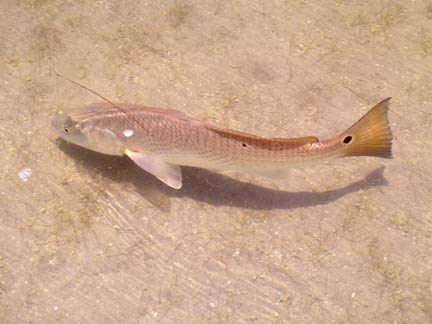 totally
unprepared for this," he said. "It looks like something out of the tropics.
It's hard to believe it's in Texas."
totally
unprepared for this," he said. "It looks like something out of the tropics.
It's hard to believe it's in Texas."
Steve Gamble, owner of the
Galletin River Lodge in Bozeman, Montana, said to me recently that fly
fishing for redfish in the LLM is in no way inferior to bonefishing in
the tropics -- and it is closer to home for most of us. Dr. Charles Moore,
a white sand aficionado from Austin, Texas, commented that fly fishing
the white sand for redfish is exactly the same as fishing for bonefish:
The water looks similar, and the stalking and sight casting approach is
identical. The only significant difference, according to Moore, is
that bonefish are easier to catch! Fred, who has fly fished extensively
in various saltwater locales, goes on to say that compared to redfish and
speckled trout, "bonefish are boring and predictable."
Of course, the beauty and
character of a species of fish is in the eye of the beholder. But if you're
looking to stalk some tough characters in a place known for its breathtaking
beauty, you might want to consider the white sand of the lower Laguna Madre.