A Much Maligned Lady
By
Capt. Kathy Sparrow
By
Capt. Kathy Sparrow
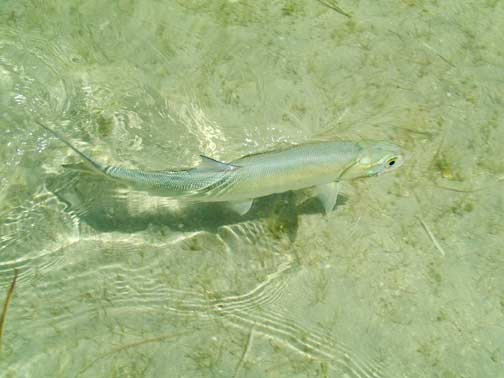
My first encounter with a ladyfish came early in my fly fishing career. My husband and angling mentor Scott was fishing not far from me. A rank novice, I had no idea what had come out of the water to nab my fly. I had to ask as I scooped up the slender fish, sporting a forked tail, a large mouth, and buggy eyes. It was a one pounder at best, and I remember most the mesmerizing effect that the dazzling colors of her scales — luminescent greens upon the silvery background -- had upon me. She was a living, breathing prism.
Despite the slick, smelly slime she left behind as she slipped from my hands, I instantly developed a fondness for her, which I kept from my Texas angling friends because her reputation was far from stately. Referred to as a skipjack, she was thought of no more than a trash fish. However, time heals all things, including reputations. In recent years the ladyfish has caught the eye of the most seasoned angler — for there is nowhere else in the continental United States where you can regularly sight cast to one of the hardest fighting game fish.
Clearly, one of my favorite quarries, I readily cast to her over other species. I eagerly await her appearance on the flats in May and mourn her departure in November. I carry with me some very fond memories. One in particular comes to mind.
It was a windless September morning in 2002. Scott and I ventured out early. We were alone, no clients in tow, and anticipated the glassy conditions awaiting us not far from the mouth of the Arroyo Colorado. We turned southward, and then angled east onto the flats, to an area just south of a spoil deposit, referred to as Bird Island. As we boated into the shallower water, wakes scattered like a starburst in every direction. We needed no other sign. We shut down and prepared to disembark on our mission.
The water was like a mirror. Images of puffy clouds floated upon the surface. As I stepped into the warm waters, my wake echoed away from me, alerting any fish within casting range to my presence. I did my best to put distance between the boat and myself as stealthily as possibly. Each step took every ounce of concentration so that the noise level remained barely audible as I waded along. Scott did the same a hundred or so yards from me.
Because of the calm conditions, we both chose topwaters in order to lure fish to us. We were in about 20
 inches
of water and the fish were not visible in the low morning light.
However, in the course of a couple of hours, we landed several trout
and redfish a piece simply by blindcasting to wakes on the calm
surface. By midmorning, I had wandered a quarter mile or so from our
boat. I was still into fish and spotted the wake of a redfish
approaching. I cast my orange VIP ahead of its path and began stripping
in a methodical, 6-inch fashion. Suddenly, out of nowhere I saw another
wake nearing my fly, shooting beneath the surface of the water like a
torpedo. My heart beat rapidly as I watched it move in for the strike.
Bam! She was on. It took me only a moment to realize the redfish I had
in my sights was out-maneuvered, and that a ladyfish was dancing on the
end of my line. She darted away from me with surprising speed. She was
soon in my backing, and she showed no sign of giving up her retreat. I
began walking with her as she leapt out of the air, sending a shiver of
excitement through my veins. She repeated her aerialized acrobatics
several times before I was able to reel her in as Scott watched from a
distance. Twenty minutes passed before I landed a Texas State Record
ladyfish, weighing in at 3.1 pounds, and measuring 24.5 inches. Had I
been up on my current events, it would also have been a new IGFA
women’s record — in fact, the largest ladyfish submitted for either the
men’s or women's world records, regardless of tippet size. Record books
or not, this was the most exhilarating fight I’d ever experienced on my
7 wt. rod. I definitely was hooked.
inches
of water and the fish were not visible in the low morning light.
However, in the course of a couple of hours, we landed several trout
and redfish a piece simply by blindcasting to wakes on the calm
surface. By midmorning, I had wandered a quarter mile or so from our
boat. I was still into fish and spotted the wake of a redfish
approaching. I cast my orange VIP ahead of its path and began stripping
in a methodical, 6-inch fashion. Suddenly, out of nowhere I saw another
wake nearing my fly, shooting beneath the surface of the water like a
torpedo. My heart beat rapidly as I watched it move in for the strike.
Bam! She was on. It took me only a moment to realize the redfish I had
in my sights was out-maneuvered, and that a ladyfish was dancing on the
end of my line. She darted away from me with surprising speed. She was
soon in my backing, and she showed no sign of giving up her retreat. I
began walking with her as she leapt out of the air, sending a shiver of
excitement through my veins. She repeated her aerialized acrobatics
several times before I was able to reel her in as Scott watched from a
distance. Twenty minutes passed before I landed a Texas State Record
ladyfish, weighing in at 3.1 pounds, and measuring 24.5 inches. Had I
been up on my current events, it would also have been a new IGFA
women’s record — in fact, the largest ladyfish submitted for either the
men’s or women's world records, regardless of tippet size. Record books
or not, this was the most exhilarating fight I’d ever experienced on my
7 wt. rod. I definitely was hooked.Members of the Elopidae family, ladyfish favor estuaries, coastal lagoons, and hypersaline bays, but also can be found in the surf. An average catch of the Elops saurus on the Lower Laguna is in the one to three pound range — the same as in the waters of Florida, Louisiana, and the Carolinas. However, in these locales they’re likely to be found in deeper channels making sight casting nearly impossible. All told, six species of ladyfish populate waters around the world, some reaching weights of 25 pounds.
Despite the ribbing I received from my diehard Texas angling friends, I soon learned that fly fishers hailing
 from other areas looked upon ladyfish with higher regard. As a guide,
I’m grateful that ladyfish can save the day when redfish and trout are
either hard to find or unapproachable due to an elevated degree of
wariness.
from other areas looked upon ladyfish with higher regard. As a guide,
I’m grateful that ladyfish can save the day when redfish and trout are
either hard to find or unapproachable due to an elevated degree of
wariness.A year or so ago, Scott guided two of our client friends from California on a balmy June day. During their first day on the crystal clear, shallow flats of the Lower Laguna, they acclimated their skills to the demands of precision sight casting, and Dan came up with a couple of redfish. Peter had an encounter with one of the ladies who nabbed his fly and ran off with it. She set her hooks into him, and at dinner that night he exclaimed, "I just want to catch one of those ladyfish.”
The next morning he and Dan were aboard my boat. After working the channel for trout and flounder, we headed east once the sun was high in the sky. We were into a sprinkling of redfish on the white sand -- a mile wide stretch that runs along Padre Island, the largest barrier island in the world which protects the Lower Laguna from the Gulf of Mexico. I was walking between the two helping them spot fish. A big red was heading Peter’s way. He got it in his sights and made the cast. I watched from a distance as the red approached. And then a silvery flash caught my eye. A ladyfish had zeroed in on Peter’s fly, and the chase was on. Inches from the redfish, the ladyfish snatched the Mother’s Day Fly (a shrimp-like pattern), and dashed off in a flash. She leapt out of the air a couple of times and also took him into his backing. Peter had gotten his wish. He sight casted and landed what is known as the “poor man’s tarpon.”
Fly fishers need not adhere to the matching-the-hatch theory when angling for this species, but it is worthwhile to note that ladyfish feed on smaller fish, shrimp, and crustaceans. They will take a number of flies without hesitation. A topwater will grab their attention on a calm morning just as it will redfish and trout. A shrimp-like pattern is also a likely candidate to lure the lady to take the bait. However, she does seem to favor a bit of flash, making a mylar fly -- such as the Ladykiller -- a pattern of choice.
Ladyfish prefer their bait to be quickly fleeing for their life. Therefore, they respond well to quick strips. Likewise, if, as in Peter’s case, you’re looking to lure another species to the fly, slowing your stripping speed down will bore the ladies, and they’ll go off looking for something else to capture their interest.
While roaming the flats, ladyfish, measuring from 18 to 22 inches, typically run in schools of a half a dozen or more, with several larger fish of 24 to 25 inches leading the pack. It’s not unusual to have several vying for your fly at a single moment. This, however, does not increase the chances for a hook-up. In the frenzy of being the first to take the fly, they very often miss, or they’ll snatch the fly lightly and toss it with their first leap. It’s wise — even after a brief hook-up — to check your tippet because ladyfish have a very abrasive mouth that will likely compromise your tippet.
Once hooked, however, be ready for a good deal of play. As several fly fishers have commented, they do
 run like a bonefish and jump like a tarpon. It’s important to allow
them to run. They’ll tire soon enough, at which point, you can exert
your superiority and reign them in. Resist the urge to palm your reel.
Not only do you risk injury, you’ll also break off. I was with a client
one day last summer who broke off on five ladyfish. The next day
history repeated itself when he was aboard Scott’s boat. There was no
other way to break his habit than to threaten to charge him $20 a fly.
run like a bonefish and jump like a tarpon. It’s important to allow
them to run. They’ll tire soon enough, at which point, you can exert
your superiority and reign them in. Resist the urge to palm your reel.
Not only do you risk injury, you’ll also break off. I was with a client
one day last summer who broke off on five ladyfish. The next day
history repeated itself when he was aboard Scott’s boat. There was no
other way to break his habit than to threaten to charge him $20 a fly.In addition to cruising the Bahamian-like, sandy bottom of the east side of the Lower Laguna, they are often found along the Intracoastal Waterway, which runs north-south from Port Mansfield to Port Isabel. They crash bait along the edge where the shallow flats meet the deeper water of the channel, and create quite a show. One morning a client landed seventeen ladyfish in the midst of a handful of 16- to 20-inch trout. A great way to start the day.
The surf along Padre Island is another venue for hooking up with larger ladyfish. Here, they’ll cavort with their cousins the tarpon, or even jack crevalle. In October 2003, Skipper Ray reclaimed the state record which I had angled from him a year earlier while casting a Clouser into the surf south of the Port Mansfield jetties. Boating close to the surf break, he'd seen birds working and cast into the balls of bait that the ladyfish were also feeding on.
“On a 9 wt. they burned my hands and knocked my knuckles,” he reminisced. “It made the day because they were so big and powerful.” His record-breaking fish weighed 4.2 pounds and measured 26 7/8 inches long, with a 10 1/2 inch girth. He and his client had caught so many that day, most in the 20-24 inch range, that they finally gave up and went searching for other quarry.
Not so long ago, Scott and I ventured onto the flats just east of Green Island, a Texas Audubon sanctuary located on the east side of the Laguna Madre. The ladyfish had been cruising the area for several weeks, so we knew it was a likely bet for some afternoon entertainment.
Scott was armed with his 5 wt. and a 4 lb. tippet, hoping to break an IGFA record. An hour into our fishing, having caught and released several one to two pound ladyfish, Scott hooked up a larger one. I continued fishing, only occasionally glancing in his direction. I knew this one was one for the books — if he could bring it in. It jumped into the air several times and threatened to spool him on more than one occasion. A half hour passed. I stopped fishing to watch the unfolding drama. Finally, the fish was at his feet and into his hands. A fine catch — all 2.5 pounds of her.
While most fly fishers fish the Lower Laguna Madre for redfish and speckled seatrout, this venue has proven to provide any angler with classic sight-casting conditions for one of the most energetic species traversing these waters. Without a doubt ladyfish can brighten any fly fisher's day, and provide a great deal of sport in which to improve your angling skills.
Capt. Kathy Sparrow is the author of On the Mother Lagoon: Fly Fishing and the Spiritual Journey. She and her husband, Capt. Scott Sparrow, own and manage Kingfisher Inn in Arroyo City, Texas.