Gunning for Gator Trout
by Capt. Scott Sparrow
an unedited version of an article
that
just appeared in theJuly/August
2003 issue of
Fly Fishing in Salt Waters
On May 23, 2002, Bud Rowland
from
Port Isabel, Texas was doing what he loves best -- sight
casting
to giant spotted, or "speckled" sea trout.
"I was drifting along," Rowland recalls, "and all of sudden, alongside
me were two huge trout." He also spotted a smaller trout
along
with the two big fish.
One of
the big trout looked to be about 30 inches long, but the other was
clearly
35 inches or more. Using his favorite big trout fly --
his own Numero Uno -- he presented to the largest fish. "It landed
about six or seven inches from her nose," he said. Rowland expected the
small trout to rush forward and grab the fly, but instead he watched
the
biggest trout slowly swim forward. "She just opened her mouth and
engulfed
that fly, and started moving," he reports. "I set the hook and the rest
is history."
the largest fish. "It landed
about six or seven inches from her nose," he said. Rowland expected the
small trout to rush forward and grab the fly, but instead he watched
the
biggest trout slowly swim forward. "She just opened her mouth and
engulfed
that fly, and started moving," he reports. "I set the hook and the rest
is history."
A few
minutes later, Rowland landed the largest speckled trout ever taken on
a fly rod, and the third largest speck ever taken on fishing tackle of
any kind -- a 37 1/4 inch, 15 lb., 6 oz. fish that later was certified
as the new IGFA 16 lb. tippet class world record. Realizing the
significance
of his catch, he waved down two fishermen, who gladly photographed him
and the trout, and witnessed the weigh-in on a certified Chantillon
hand
scale. And then, as Rowland went to release the fish, the incredulous
onlookers
offered to rescue the trout from an obscure old age by offering to buy
it: They thought she deserved, at least, to be mounted. But
Rowland
released her anyway. "I release nearly all of my big trout anyway, and
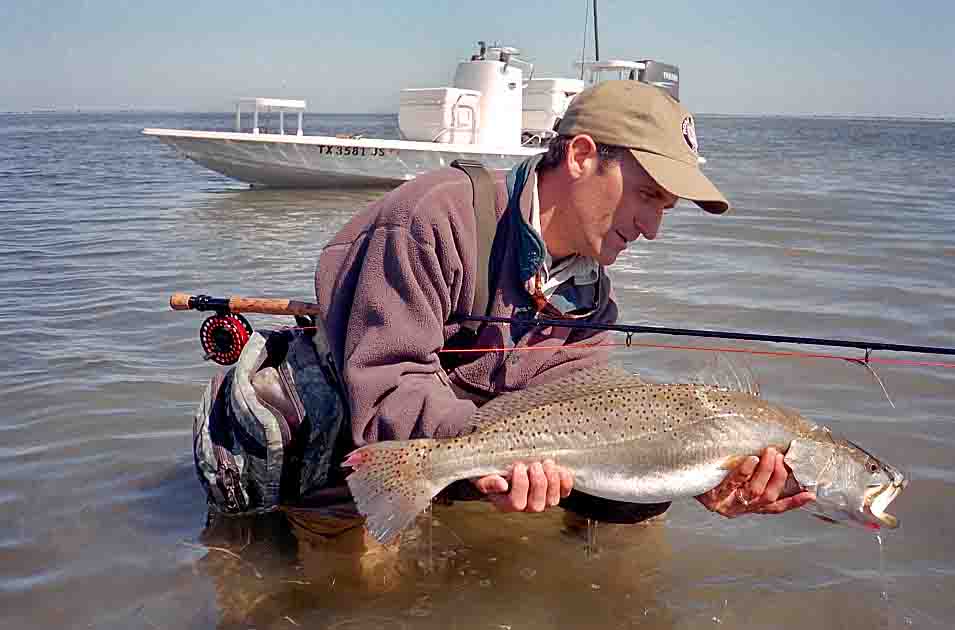
now her genetics can continue in our bay system," he said. (Photo is of
Bud with a smaller trout.)
Edward
R. Hewitt once pointed out that as a fly fisher matures, he eventually
grows weary of catching the most and the biggest fish, and finally
turns
to the most difficult ones. For those of us to whom difficult
fish
have become alluring, there is no greater angling challenge than giant
speckled trout, for they are among the most difficult gamefish to be
found
anywhere. "Tougher than permit!' 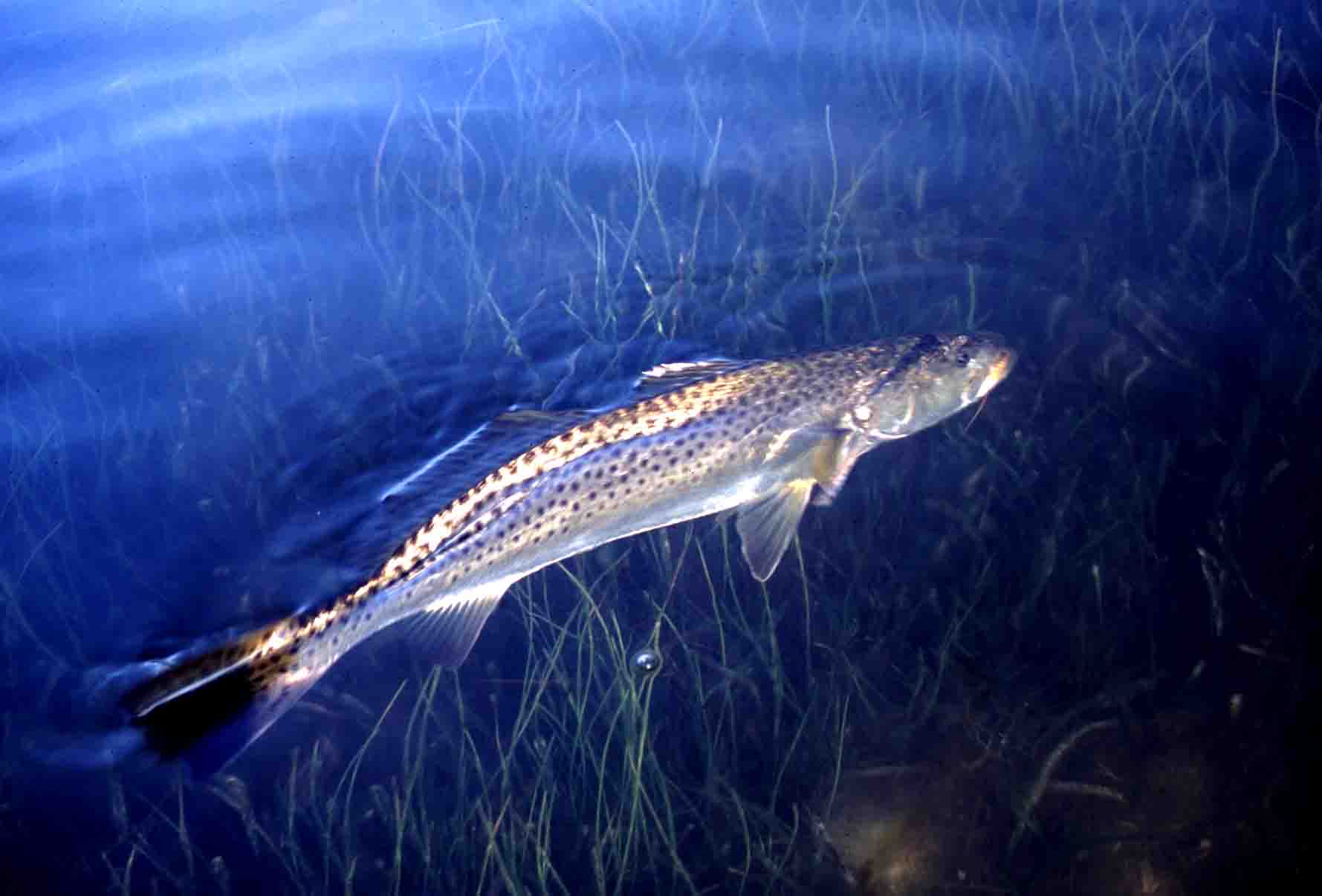 asserts
one master fly fisher. "Psycho!" exclaims another. But these men also
smile
when they speak of her. Indeed, if this fish were a disreputable lady,
the passion that she would generate in a few would be more than enough
to protect her from the contempt of the many.
asserts
one master fly fisher. "Psycho!" exclaims another. But these men also
smile
when they speak of her. Indeed, if this fish were a disreputable lady,
the passion that she would generate in a few would be more than enough
to protect her from the contempt of the many.
Top
Venues. The spotted seatrout, or cynoscion nebulosus ("starry
nebulae")
is a member of the croaker family, and inhabits estuaries and inshore
waters
from Massachusetts to the Yucatan peninsula. However, the largest
specimens
that have been taken on a fly rod have been caught in the 152-mile long
Indian River lagoon system on the east coast of Florida, and on the
Lower
Laguna Madre of deep south Texas. Florida and Texas fly fishers
continue
to monopolize the IGFA’s world records in the open division -- with
fish
from 8 1/2 pounds to over 15 pounds. If records mean anything,
the
Lower Laguna is currently the premier venue for trophy specks, claiming
five out of seven of the tippet class world records. Bud Rowland
alone claims three of the five Lower Laguna records -- the 4 lb, 6 lb
and
16 lb records -- and would have racked up a fourth world record in May
of 2001 if he hadn’t released a 10 lb. trout before weighing it,
believing
that it must have been too small to qualify.
The
Lower
Laguna is the only true subtropical fishery outside of Florida in the
continental
U.S., and is remarkable among trout fisheries for its sight casting
opportunities.
While the Indian River Lagoon system has an average depth of three
feet,
the 300-square mile Lower Laguna averages just over a foot of normally
clear water. And while the trout in the Indian River Lagoon System
migrate
in and out of the shallow water in response to water temperatures, the
trout in the Lower Laguna evidence very little movement to and from the
Gulf inshore waters, and can be found on the shallowest flats during
the
warmest and coldest seasons, alike. Indeed, the Lower Laguna is truly
unique
in offering year-round sight casting to world-record class fish.
Trout
development. Before speckled trout reach the spawning age of two
years,
and a length of about 15 inches, they feed on shrimp and tiny baitfish
and, while feeding, will usually attack just about anything that you
toss
in their direction. Indeed, small topwater and subsurface flies will
draw
as many as a half dozen slashing strikes on a single retrieve through a
school of feeding trout. Fly fishers can easily catch a dozen small
trout
on Clousers under dock lights at night, or by blindcasting topwaters
along
the edges of channels on summer mornings.
The
largest
trout are females, with the males rarely growing beyond 20 inches in
size.
A six year-old male will average 19 inches in
length, while a six-year-old female will run around 26 inches. These
"sow"
trout tend to feed only two hours out of every 24-hour cycle, and when
they do feed, they usually gorge themselves on large baitfish such as
mullet,
pinfish, or pig perch. Feeding infrequently, and roaming the shallowest
waters as solitary hunters, trophy trout behave like a different animal
altogether from their younger kin. If small trout are among the easiest
prey for fly fishers, large trout are among the most difficult.
After
casting fruitlessly to over 20 trout from 4-9 pounds apiece, a visiting
fly fisher -- who has fly fished the world over -- said to me, "This is
the most difficult sight casting I’ve ever encountered!" He's not alone
in this assessment.
Finding
the Fish. Locating trophy speckled trout is at least half the
challenge,
for their movements are as arcane as any fish to be found. Still, a
dedicated
angler soon learns that trout follow fairly predictable patterns.
Trout gravitate toward structure, such as along channel dropoffs; on
the
edge of depth transitions; along the banks of spoil islands; and on top
of submerged spoil islands. Furthermore, the same fish will often
return
to the same structure day after day for a period of weeks, or even
months.
Big trout can also be found cruising the structure-free, open flats
where
the water is especially clear and consistently shallow. Small trout
rarely
go onto the shallowest flats due to their vulnerability to pelicans,
cormorants,
and herons; but trout from 20 inches up gravitate toward these areas
whenever
the water temperature becomes attractive to them. In the winter, trout
-- and redfish, too -- will predictably go shallow during the
second
or third day of a warming trend. In the summer, they will go skinny
after
a cool night, after a rain has cooled the shallows relative to the
deeper
water; or after a flood tide has pushed cooler water into the shallows.
While
trophy trout are usually quite willing to take a fly on the open flats,
it is usually difficult to present the fly before the fish spots you.
When
a well-known fly fishing author was wading with me recently on the
Caribbean-like
"white sand" of the Lower Laguna Madre, we took one step in the
direction
of a huge trout that swam into view about 90 feet away, and she
promptly
turned away. Clearly, the fish had seen us. While the trout's reaction
was par for the course, there are times when a big trout will swim
right
up to you, too. Given their unpredictability, one of the
fly
fisher's greatest allies is time -- lots of it -- on the water. When I
asked my fly fishing buddy, Cecil Marchant, "What is the secret to
catching
big trout on a fly rod?" he said, "Just being there. Just paying your
dues."
Expert
fly fishers -- such as Rockport guide Chuck Scates -- often have the
necessary
skill and experience to take advantage of  those
occasions when nature rewards our persistence. Indeed, when Scates came
upon a congregation of huge trout in July of 1989, he was prepared to
make
angling history.
those
occasions when nature rewards our persistence. Indeed, when Scates came
upon a congregation of huge trout in July of 1989, he was prepared to
make
angling history.
Scates
was guiding out of South Padre Island at the time, and had been off the
water for a week recovering from sunstroke. Since he had some clients
arriving
the next day, he went out alone to see if he could handle the
boat
and find some fish.
For some
time, Scates had been fishing for IGFA world records, and he had a rod
outfitted with two-pound class tippet for redfish, and a rod with
heavier
tippet for trout. As he approached a spoil island where he often
fished,
he spotted dozens of fish with their backs out of the water, driving
mullet
toward the shoreline. Thinking that the fish were redfish, Scates
grabbed
the rod with the two-pound tippet, and waded toward the fish. Then he
realized
that they were huge trout! After hooking and breaking off on two fish
--
one of which would have gone over 10 pounds -- Scates finally landed an
8 lb, 11 oz. trout that broke the IGFA two-pound class tippet record.
Fourteen
years later, his record still stands.
Skipper's Maxim
A fly
fisher
will often express surprise when a trophy trout flees so quickly and
decisively
from his first presentation, and will often blame the fish or the fly
for
the rejection. I am convinced, however, that a big trout's so-called
finickiness
usually stems from having already sensed the angler's presence. Lower
Laguna
Madre guide Skipper Ray agrees. In fact, when I recently asked him,
"What
is the secret to catching big trout on your fly rod?" he replied, "See
the fish before she sees you" -- as if this should be the most obvious
thing in the world. But it isn’t always the first thing that fly
fishers
consider. Nor is it easy to accomplish once you’ve embraced it as your
first order of business. But as Sparse Gray Hackle once asserted,
"The real expert is always willing to credit the fish with the
inordinate
wariness which it always manifests, and he is willing to take the
trouble
to stalk as he should."
For fly
fishers willing "to take the trouble," there are a variety of
strategies
that can help them fulfill Skipper’s maxim.
Maintain
a low profile. If the bottom is firm enough, wading is an excellent
way to avoid being noticed. For myself, I don’t hesitate to take it a
step
further by dropping to my knees in shallow water whenever I see a big
trout
nearby. If the bottom is too soft to wade, using a kayak is an
effective
alternative for getting within casting distance. Bud Rowland and fly
shop
owner Larry Haines frequently fish for big trout from aboard their
Wilderness
Systems "Ride" offshore kayaks. The wide and stable, sit-on-top
design
of the Ride permits fly fishers to stand while casting, or to ride side
saddle when they want to "scoot" slowly along.
A low
profile is also ideally paired with an intentionally non-aggressive
stance.
It's important to move slowly and deliberately, and to blend in to the
natural order. I have even observed that trout will acclimate to your
presence
if you act in a nonaggressive manner. Lower Laguna fly fisher Tom
Kilgore
-- who held the four-pound tippet world record trout until Bud Rowland
edged him out -- refrains from even looking at a big trout that he has
spotted, having observed that big trout do not react as much to a
person
who is just going about his business. Kilgore also keeps his arms to
his
side as he casts to visible big trout -- again in order to minimize the
appearance of aggression.
 Go
slow, and then go slower. Speckled trout are masterfully
camouflaged
on the dorsal side, with brown and green interspersed with the black
spots
for which they are named. Consequently, they are exceedingly difficult
to pick out, especially on a dark, grassy bottom. To be successful at
stalking
trophy trout, you have to move so slowly that you have a chance of
seeing
the trout before she becomes offended by your presence. This takes an
unshakable
belief that a big trout may appear at any moment, and a relentless
scrutiny
of every nuance of your surroundings. Unless a wading angler
stops
and studies the water with consummate thoroughness, he will spook most
of the fish before he sees them. Learning to see the "lifeless" tip of
a trout’s tail above the surface, the black edge of its tail moving
below
the surface, or the subtle snakelike movement of its dorsal fin amid a
school of mullet, can make the difference between catching a big trout
and never seeing one.
Go
slow, and then go slower. Speckled trout are masterfully
camouflaged
on the dorsal side, with brown and green interspersed with the black
spots
for which they are named. Consequently, they are exceedingly difficult
to pick out, especially on a dark, grassy bottom. To be successful at
stalking
trophy trout, you have to move so slowly that you have a chance of
seeing
the trout before she becomes offended by your presence. This takes an
unshakable
belief that a big trout may appear at any moment, and a relentless
scrutiny
of every nuance of your surroundings. Unless a wading angler
stops
and studies the water with consummate thoroughness, he will spook most
of the fish before he sees them. Learning to see the "lifeless" tip of
a trout’s tail above the surface, the black edge of its tail moving
below
the surface, or the subtle snakelike movement of its dorsal fin amid a
school of mullet, can make the difference between catching a big trout
and never seeing one.
Learn
to see tailing trout. In the midsummer, when the tides are low, big
trout can often be seen tailing on calm mornings. But few of the
anglers
I’ve interviewed over the years have ever actually seen one. When Jim
Kuper,
a fly fishing writer, came down a couple of years ago to do some
articles
on the Lower Laguna, he asked, "What do you think would make an
interesting
angle?"
"How about tailing trout?" I answered.
"I have
fished the Texas coast for years," he remarked. "but I can’t say that I
recall ever seeing one."
We went
out before sunrise to a grassy flat adjacent to the Intracoastal
Waterway,
and anchored. As the sun approached the horizon, we looked out across a
flat that is usually overlooked by anglers on their way to more remote
settings, and saw, in Kuper’s words, "five acres of tailing trout."
Using
a VIP topwater, Kuper slipped out of the boat and proceeded to catch
several
trout up to 24 inches that were tailing in the foot-deep water.
In most
instances, a tailing trout barely breaks the surface as it forages head
down on a grassy flat. Typically, the tail will appear as a tiny black
triangle. When compared to a wiggling sheepshead tail, or a waving
redfish
tail, a trout tail is easy to overlook. But once you see the first one,
you’ll know what to look for, and your chances of success will be
greatly
enhanced.
Remain
poised for a quick cast. Once you spot a trout, you have to cast
quickly,
because as soon as the fish moves, you will probably lose sight of her
due to her camouflaged coloring. Trout also move erratically when
foraging,
so it's hard to predict where they will go once you lose sight of
them.
To remain poised for quick action, most of the fly fishers I know use
stripping
baskets while wading. In particular, Kathy and I favor an innovative
stripping
basket called the Strip'n Aid, made by Lake Fork Industries of Waco,
Texas.
Having relied upon this toothy contraption for almost four years -- and
urged our clients to do so, as well -- we have observed that it greatly
decreases a fly fisher's response time, and clearly results in at least
50% more hookups on big trout and redfish alike.
While
stalking big trout, in particular, I have developed a casting method
that
I call the Heron Haul, which can be used alone or in conjunction with a
casting basket.
To use
the Heron Haul, you first aerialize the amount of line that you can
comfortably
lift off the water, and lay it on the water directly behind you. Then,
facing forward, you hold your rod over your shoulder so that the tip of
the rod points backward and downward so that there is no slack between
the rod and line. Strip a bit of line off the reel and hold it in your
left hand high against your chest, so that you'll be ready to cast.
Walking
forward, simply drag the line behind you. When you spot a fish, haul
downward
with your left hand as you make your forward cast. It's important to
start
your forward cast slowly, as you would normally do on your initial back
cast. This will allow the rod to load properly, and will keep the line
from tracking too low and hitting you.
If you
are using a stripping basket, you can shoot some or all of the line on
your basket on your second forward cast. Once you become adept at the
Heron
Haul, you can even shoot some line off of your casting basket on your
first
forward cast. Most of the time, however, you’ll need at least one false
cast to reposition your line after the water haul, and shoot the
remaining
line toward your target.
The
Heron
Haul achieves the goal of minimizing body movement and false casting,
but
it's not always possible to use it. If you have a tail wind above 15
knots,
the wind may blow the line toward you, thus ruining your slackless
forward
cast. Also, if there’s a lot of floating grass, you may not be able to
drag your fly without fouling it. Using a weedless fly helps, but there
are some days when you just can’t afford to drag the fly behind you.
Fish
from aboard a drifting or poled skiff. Although fishing from
aboard a boat may seem to contradict the low-profile philosophy,
novices
have to learn to see big trout before they can sight cast to them. By
spending
time aboard a boat with an experienced angler or guide who can point
out
the fish, a fly fisher can develop the sighting skills that will
translate
into success, regardless of whether he continues to fish from aboard a
boat, or decides to wade.
At the
other end of the continuum of experience, advanced fly fishers can
exploit
the greater visibility afforded by the boat, and actually catch some of
the fish they see by making precision casts within seconds of spotting
a target. Bud Rowland believes that sight casting from a boat
represents
the best overall approach to fly fishing for trophy trout. While
he often wades or uses his kayak on calm morning, his method of choice
is to fish from his boat from midmorning until midafternoon, while the
sun is more directly overhead. With the sun and the prevailing
southeast
wind behind him, Rowland can often approach within a few feet of big
trout
before they see him. Indeed, he has caught most of his trophy trout
making
short, precision casts from his drifting boat.
Blind
Casting Tactics. Whenever it’s calm and/or sunny, it’s usually
better
to refrain from casting until you see a tail, a wake, or a cruising
fish
beneath the surface. But when windy and cloudy conditions
prevail,
every fly fisher going after big trout should have an effective blind
casting
plan.
One
approach
that is effective during the summer months, in particular, is to cast
topwaters
along the edge of the Intracoastal Waterway, and strip them back onto
the
flat. Big and small trout alike often feed right on the edges of
channel edges -- especially on the outgoing tide -- so this strategy
can
reap dozens of strikes over the course of a few hours, even on windy
mornings.
After the sun rises, the topwater action usually falls off, but by
switching
to small Clousers, the fly fisher can extend this action for another
hour
or more.
Under
low light, but calm conditions, I often combine limited blind casting
with
sight casting by making short casts in all directions, and leaving a
sizable
"donut" of reachable water untouched. While I'm stripping, I will study
the untouched water for signs of cruising or tailing trout, and
reposition
the fly as soon as I spot a target.
When the
sun is bright, but the water is too deep to see individual fish, an
effective
strategy is to cast to "potholes" -- light-colored openings on an
otherwise
grass-covered bottom that tend to be a bit deeper than the surrounding
area. Big, solitary trout are famous for lying up in potholes,
where
they warm themselves on a chilly day, and attack approaching bait from
below. While you can easily spot a pothole with polarized sunglasses
from
some distance away, it is often hard to see a trout lying up in one,
even
if you're only a few feet away. So it’s a good practice to imagine that
each pothole harbors a big trout, and to put your topwater fly over the
middle of it. Subsurface patterns work well over potholes, too, and are
usually superior as the day progresses.
Flies for Trophy Trout (See our page on fly designs for illustrations for these flies.)
Given
a
trout's tendency to feed only two out of every 24 hours on large
baitfish,
it makes sense that they would only rarely take any offering,
regardless
of its size. And if they were hungry, it also makes sense that they
would
overlook small flies in favor of large baitfish imitations. However,
Bud
Rowland -- whose successes lend credence to his claims -- says that
both
assumptions are false, and that big trout will eat just about any
well-presented
fly at any time. In support of his bold contention, Rowland recently
caught
a trout over 10 pounds on his fly rod on a size 6 Numero Uno fly. When
he landed the trout, Bud discovered a half-digested, regurgitated
10-inch
mullet hanging from its mouth. Such anecdotes point to pure aggression
as a prime impulse behind a big trout's strike.
Large
trout readily take both topwater and subsurface flies of various
descriptions.
Most fly fishers I know opt for topwaters in the early morning when the
light is low and the wind is calm, and then switch to subsurface flies
by midmorning.
Side Bar
on fly selection with slides to illustrate.
Topwater Patterns, from top
to bottom. Some fly fishers use large, tightly stacked
deer-hair
flies like Larry Haines' Mae West pattern, or a similarly well-endowed
deer-hair mullet. The problem with flies comprised exclusively of
deer hair is that they tend to get waterlogged, and if they're large
enough
to float for long, then they’re also difficult to cast. For that
reason,
I have developed the VIP popper, which has a small foam head in front
of
stacked deer hair. The VIP casts easily, floats low in the water,
remains
buoyant all day, and makes more noise than deer hair. Indeed,
Kathy
and I rarely anything else from dawn until midmorning.
For
conditions
requiring a delicate presentation, Skipper Ray prefers a Wilson’s Grass
Shrimp, a variation of the Gartside Gurgler.
Subsurface
Patterns, from top to bottom. Size and color preferences vary for
subsurface
flies, too. For years, Chuck Scates has favored a chartreuse-and-white
Deceiver (top). Tom Kilgore depends on a large red and pink Deceiver
that
he calls his Thousand Dollar pattern, because he once caught a
tournament-winning
trout with it. Skipper Ray usually prefers red and white
Seaducers
-- sometimes with a rabbit strip as a trailer. However, when conditions
call for a delicate presentation, Skipper opts for a lightweight fly
called
a Winslow Whisper.
Larry
Haines uses a small Lite Brite Minnow for big trout, and believes that
big eyes are an important trigger for trout. Meanwhile, Bud Rowland has
caught most of his world-record trout on his Numero Uno fly, tied in
various
color combinations on size 4 to size 8 hooks. Kathy and I like to
use Deceivers in the wintertime when the fish are feeding largely on
baitfish,
and a Mother's Day Fly tied on size 4 and 6 hooks -- during the warmer
months, when the shrimp are on the flats.
It is
probably true that when it comes to trophy trout, the size of the fly
represents
a tradeoff between imitation and ease of use. Large flies imitate
the primary food sources of big trout, but may hinder your
presentation,
while small flies represent less important food sources, but may
facilitate
a precision cast. Since big trout are merciless in rejecting poor
presentations, and willing to attack a fly of any size that is
presented
well, a smaller fly may represent more of an advantage than a drawback.
Use
flies with different sink rates. Tom Kilgore insists that a
fly's
sink rate is an often overlooked key to success. Big trout move
erratically
when they are hunting. On a vegetation-free flat, they will often
rush to seize a fly from 10 feet away, but in grassy conditions, they
tend
to overlook anything that's not "in their face." Thus, in water
over
15 inches deep, it is important to use a fly that sinks fast enough to
get directly in front of the fish before she swims under the fly, or
changes
direction. For this reason, Bud Rowland wraps his hooks with varying
amounts
of lead wire before he dresses the fly, and codes the flies according
to
the sink rate.
Use
patterns that undulate. Flies that undulate at rest seem to
provoke
more strikes, especially when the trout are not actively feeding.
Indeed,
trout will sometimes go into a virtually unresponsive, sleep-like state
between feeding periods. While many anglers declare these fish
uncatchable
and move on, Skipper Ray uses a Seaducer with a bunny strip
trailer
to tease these sleeping giants into striking. He casts the Seaducer in
front of the sleeping fish, and lets it sit there until he sees the
fish
move. Then, the mere twitch of the fly will often provoke a strike.
Similarly,
Bud Rowland outfits his Numero Uno with twister tails and "Flexi Legs"
to provoke these lethargic fish to action. He sweeps the Numero
Uno
by the sleeping fish again and again until it provokes a strike.
Similarly, I use Dupont Lumaflex -- sold as "Flex Floss" by Spirit
River
-- for tailing and/or legging on most of my VIP poppers and Mother's
Day
Flies.
Just the other day, for instance, Kathy and I were wading along the shoreline of Laguna Atascosa National Wildlife Refuge on a sunny afternoon. After 15 minutes of wading through a turtlegrass meadow, I spotted a large trout on the edge of a pothole. I cast my Mother's Day Fly to the fish, and it landed a bit too close. The fish spooked, and swam a few feet before slowing down. I presented my fly two more times, but the trout recoiled more violently each time until she was out of sight. I almost changed flies, but upon honest reflection, I knew that my presentation had been the problem, so I stayed with the fly.
 I
continued wading for a while without seeing another fish, but finally I
spotted the shadowy form of a slow-moving trout about 70 feet away. I
stripped
off more line and casted, and again the fly landed too close for
comfort.
The trout spooked slightly, but quickly resumed her unhurried pace. On
the next cast, the fly landed gently about two feet from the fish. I
lost
sight of the fish for a moment, but then she came out of the
water,
shaking her head and trying to throw the fly.
I
continued wading for a while without seeing another fish, but finally I
spotted the shadowy form of a slow-moving trout about 70 feet away. I
stripped
off more line and casted, and again the fly landed too close for
comfort.
The trout spooked slightly, but quickly resumed her unhurried pace. On
the next cast, the fly landed gently about two feet from the fish. I
lost
sight of the fish for a moment, but then she came out of the
water,
shaking her head and trying to throw the fly.
After a spirited 10-minute fight, I landed an 8 lb, 2 oz. trout. Before releasing her, I held her in the water and admired her. Her silvery body was almost blinding in the afternoon sunlight, and her golden mouth was positively cavernous. I turned the fish slightly so I could to see the sweep of iridescent pink behind her gills, and the constellation of spots for which she was so aptly named “starry nebulae.” As the trout swam away, cloaked in the browns, blacks and greens of her mottled back, she merged seamlessly with the backdrop of seagrasses, and became another fond memory.
Most fly fishers would agree that saltwater fly fishing is difficult enough without going after a fish that is harder to catch than a permit. But there’s a place in this world for mountains as high as Everest, and fish as difficult as trophy speckled trout -- and a place, as well, for anglers who set their sights above the known horizons.