A Fly Fisher's Quest
by G. Scott Sparrow
To purchase photos by Scott
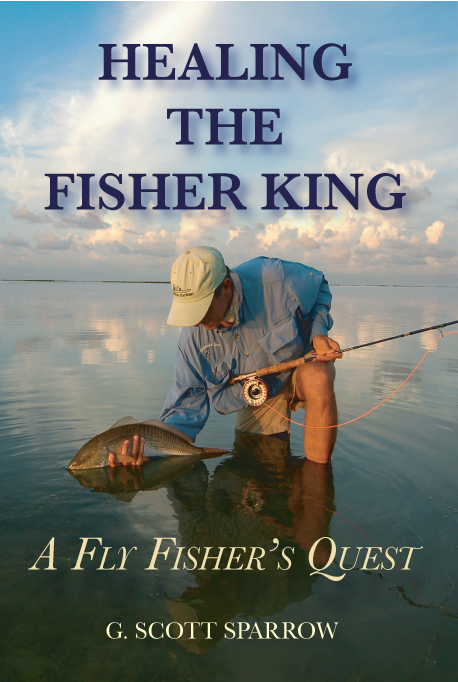
Publisher: BlueMantle
For review copies contact:
Kathy Sparrow
956-748-4366
kingfisher@lagunamadre.net
Press Release Announcing the Publication of
Healing the Fisher King:A Fly Fisher’s Quest
by G. Scott Sparrow
In the tradition of MacLean’s A River Runs Through It and Dodson's Faithful Travelers, the book Healing the Fisher King: A Fly Fisher’s Quest by G. Scott Sparrow, is the story of one man’s fly fishing quest in 1997 to the familiar waters of his childhood –– to the South Texas, primitive coastal estuary known as the Lower Laguna Madre.
Lured by a desire to catch a giant speckled trout on his fly rod –– but directed by a luminous dream that points to the Laguna Madre as the setting for healing and transformation –– Sparrow takes his boat and his eight-year-old son on a journey from Virginia to South Texas that proves more difficult and more meaningful than he imagines. He soon discovers that the unresolved pain in his life –– stemming, in part, from his parents’ divorce and now his own –– is also alive in his son, who feels deeply wounded and angry at his father for leaving him. As they spend the first ten days fishing together, Sparrow and his son spiral into a dark place that is, at first, confusing and disturbing. The author draws upon the legend of the Fisher King and the Holy Grail, Jungian psychology, and his family’s past in order to arrive at a way to address his son’s needs, as well as his own. Their time on the water
 culminates in a powerfully moving exchange that opens the way for a
more trusting relationship between father and son.
culminates in a powerfully moving exchange that opens the way for a
more trusting relationship between father and son.As the author begins his concerted fly fishing search for the fish so aptly named named cynoscion nebulosus (i.e. starry nebulae), his experiences soon reveal the spiritual dimensions of the quest, in which the search for a great fish mirrors his lifelong yearning for communion with God. Making his way slowly toward the great fish and the wholeness that he seeks, he must, however, confront his own “shadow” before he can proceed any further toward the goal. He is led throughout by radiant dreams, mystical encounters, his knowledge of spiritual traditions, and a willingness to face his own past with ruthless honesty.
Sparrow then confronts a new initiation brought on by the appearance in his dreams a feminine presence, who seems intent on bringing him to an awareness of what he has done all his life –– recoiling from his feelings, breaking promises, and denying his deeper needs. He relives earlier experiences in which he remained aloof from his heart, including an encounter with a Mexican prostitute when he was 15, the loss of a beautiful hawk through his negligence, and his failure to catch the fish of a lifetime in the Blue Ridge Mountains of Virginia.
Against a backdrop of rich, but largely failed fly fishing experiences, Sparrow considers how his parents fell short of their own dreams, and realizes that he has to follow his own path, rather than to live out a pattern of denying his soul’s sincere desire. While he makes progress toward understanding his lifelong resistance and how it affects his fly fishing efforts, Sparrow nonetheless sets the stage –– by breaking a promise that he makes with God –– for an eventual encounter with death through the agency of a stingray’s painful wound. Becoming infected with Vibrio vulnificus, a deadly bacteria in the cholera family, he eventually realizes that he has a choice –– to live fully, or to die.
The resolution of this crisis parallels the author’s consideration of the importance of the body on the spiritual journey. Drawing on his own past, his mother’s search for meaning, and examples from Tibetan Buddhism and Medieval Christianity, Sparrow becomes aware of the grief he holds concerning his mother and the debt he owes her for giving him life. With the help of his mentor and Jungian therapist Chas Matthews –– to whom the book is dedicated –– Sparrow experiences a powerful encounter with his mother’s memory that paves the way for his emotional rebirth.
In the end, he invites Kathy –– the woman whose love he spurned at the beginning of the journey –– to join him for the end of his retreat. With Kathy by his side, Sparrow meets new tests that spring up around his relationship with his brother. Meanwhile, Scott and Kathy find themselves being drawn inexorably into the natural realm –– to the point where a sense of oneness is experienced through dreams and remarkable encounters with the animals that inhabit the Laguna Madre. In the end, Sparrow experiences the beginning of a new life that awaits him.
Sparrow’s extraordinarily intimate relationship with Spirit and his candor about his own struggles puts the reader in touch with ageless spiritual truths grounded in the immediacy of human contact.
Gregory Scott Sparrow, Ed.D. is an Assistant Professor at the University of Texas-Pan American, where he teaches in the graduate counseling program, and a faculty member at Atlantic University in Virginia Beach. He is also a Licensed Professional Counselor in Texas, a Licensed Marriage and Family Therapist in Virginia, a writer, and a fly fishing guide and casting instructor. Sparrow has also written Lucid Dreaming: Dawning of the Clear Light (ARE, 1976), I Am with You Always: True Stories of Encounters with Jesus (Bantam, 1995), Blessed Among Women: Encounters with Mary and Her Message (Harmony, 1997), Sacred Encounters with Mary (Ave Maria, 2002), Sacred Encounters with Jesus (Ave Maria, 2003), and Andrew's Quest for the Perfect Christmas Gift (WPB, 2005). He and his wife, Kathy, own and manage Kingfisher Inn, a saltwater fly fishing lodge on the Lower Laguna Madre of deep South Texas.
Retail paper is $21.95 and hardcover is $32.95. ISBN 1-929841-28-0 (softcover) and 1-929841-29-9 (hardcover).
Excerpt from Chapter One: The Mother Lagoon
Note: Each chapter begins with a journal entry dated during the
summer of 2002. The chapter itself concerns events in the year of 1997.
Note: Each chapter begins with a journal entry dated during the
summer of 2002. The chapter itself concerns events in the year of 1997.
Journal entry: Tuesday, July 30, 2002
Arroyo City, Texas
A Disturbing Dream
A stingray lay unmoving at my feet in the shallow, clear water. Before I could move out of its way, it transformed into a man of stone and began to attack me. Sensing that he intended to kill me, I desperately defended myself and eventually prevailed, but only after chipping away at him, piece by piece, until there was nothing left of him.
Three days after the dream, almost to the minute, my alarm clock sounded at 4 a.m.
I got out of bed and went upstairs to awaken my friend Tim Clancey and my son, Ryan. The first day of the 64th annual Texas International Fishing Tournament (TIFT) would commence at sunrise, and I intended for us to be on the water, ready to fish, by first light. Tim had come down from San Antonio to compete with me in the tournament, and Ryan — who had only recently begun to fly fish — had decided to go along and help us with the boat. It was a “kill” tournament — one in which the contestants take dead fish to a weigh-in — and I’d promised myself never to fish one again. But when Tim expressed interest in fishing together, I decided to fish the TIFT one last time.
The night before, I had become obsessed with the idea of staking out a place called the Trout Bar — my favorite big trout venue — before the other contestants arrived. Having won the TIFT fly fishing division the first time I entered it two years before, I knew that catching a big trout was the key to winning. As I rushed around in the wee hours of morning packing gear and grabbing a bit of breakfast, I failed to visit the bathroom — an omission that can ruin my day.
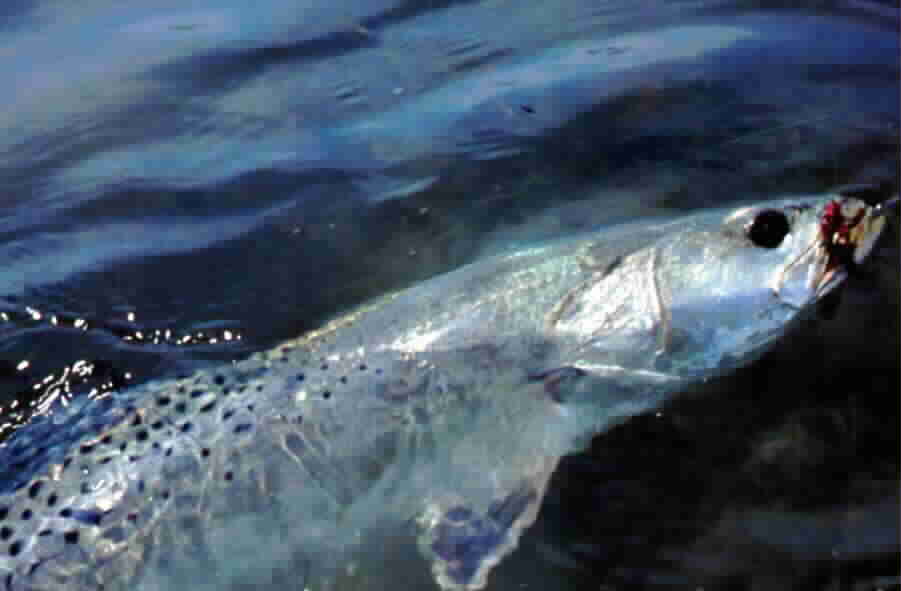 It was so dark when we left the dock that we had to
use a Q-beam to guide us on our eight-mile journey. Even with the
searchlight’s help, I overshot our destination and had to circle back
to locate the exact spot. Planing onto the edge of the flat, I turned
off the motor and poled quietly into an area that’s famous among local
anglers for hosting the largest speckled trout in the bay — if not the
world. Meanwhile, the running lights from several boats could be seen
approaching from the south. We had arrived first, and the Trout Bar was
ours.
It was so dark when we left the dock that we had to
use a Q-beam to guide us on our eight-mile journey. Even with the
searchlight’s help, I overshot our destination and had to circle back
to locate the exact spot. Planing onto the edge of the flat, I turned
off the motor and poled quietly into an area that’s famous among local
anglers for hosting the largest speckled trout in the bay — if not the
world. Meanwhile, the running lights from several boats could be seen
approaching from the south. We had arrived first, and the Trout Bar was
ours.
It was against TIFT rules to begin fishing before sunrise, so we spent some time preparing our gear and joking around. Ryan was in rare form, obviously excited to be a part of “the team.” Then, feeling the urge to relieve myself before the tournament began, I stepped off the boat and waded toward a nearby spoil island.
Ryan asked, “Where are you going, Dad?”
“To the men’s room,” I replied.
He began to make fun of me, but I knew if I didn’t follow through, I’d be miserable later. As I approached the south island of the Trout Bar, the black skimmers and black-necked stilts that were nesting there began squawking and hovering overhead as I searched for the largest black mangrove to crouch beside, as if anyone could see me in the twilight. Burying the evidence of my intrusion under a pile of dead seagrass, I started back toward the boat. Instead of wading carefully, I moved quickly — deep in thought and eager to begin the day.
My thoughts centered on finding and catching big trout, instead of attending to the task at hand. Distracted by that singular aim, I took a step, and when my right foot came down, I felt a sharp, stabbing pain that quickly rose to almost intolerable levels.
“Oh God!” I yelled. It felt like a hot knife had sliced through my ankle, leaving behind the signature of something coldly impersonal. I could barely keep walking, as almost immediately my leg muscles locked up from the pain.
“What happened?” Tim yelled, with alarm in his voice.
“A stingray got me!” I yelled back.
Tim and Ryan piled out of the boat and came to assist me. As I stood there waiting for them, I realized that the stingray’s wound had been foreshadowed by the ominous dream three days before and by a number of other dreams, as well. Indeed, a series of experiences beginning in 1996 pointed to my return to my home waters and to an encounter with an stingray.
The year of 1996 proved to be a particularly difficult time. I had left my marriage two years before, and my seven-year-old son lived a mile away with his mother. Meanwhile, I had pursued a new relationship that was doomed from the outset and eventually came to a nightmarish end in the late summer. I recall sitting at my dining room table, talking to a Virginia Beach policeman, who was 20 years my junior, but wise enough to ask the obvious question, “Why do you let her back in?” I replied, of course, “Because I love her.” But I discovered, as so many of us are destined to learn in time, that love is not always enough.
Free, at last, from the turmoil, but not the grief of ending that relationship, I visited bars almost nightly, and I drank too much beer on too many occasions before admitting the futility of that empty source of solace. After my friend Giles voiced his concern, I consented at last to spending my nights at home, sober and alone. By day I was a therapist, helping others. By night, I felt broken and invisible.
On a cold evening in mid-January 1997, I took the first tentative step in my journey homeward by beginning to reminisce about the place where my father had taken me fishing when I was a child — the Lower Laguna Madre of deep South Texas.
Of all of the places and people I had known, it alone called to me.
When Jesus chose his first disciples, he selected several men who had fished for a living. People who do not fish may consider this fact irrelevant. But those of us who do fish — if only for sport — and who enjoy the companionship of others who do, can imagine what Jesus might have seen in the likes of Peter, James, John, and Andrew. For the dream of catching a big fish is not unlike the dream of communing with God: The fisherman and the mystic alike are driven by a yearning for something elusive and essential just below the surface of ordinary life. Whether we think of it as a great fish or as God himself who beckons us onward in our quest, it feels remarkably the same.
Some of my first memories on the Gulf Coast of South Texas are of blue crabs and piggy perch, and of my father untangling my fishing line, again and again, on the dock below the cottage. Dad was always patient, and looking back, I realize now that this was his gift to me.
We lived 45 miles inland, but we spent many of our summer weekends at the cottage on the Arroyo Colorado. Dad had “inherited” the cottage from my mother’s entrepreneurial father who had suffered a financial setback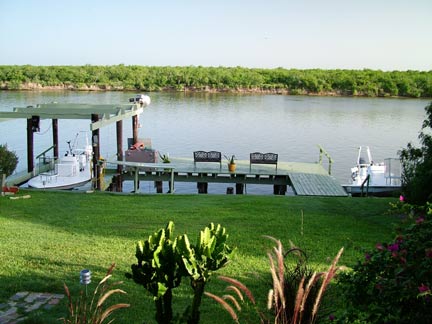 and could not afford to keep up the
payments. So Dad, who would never have bought such a place for himself,
took it over for several years until his penchant for self-denial under
the guise of prudence prompted him to sell it for $4,000. I can
remember that for many years afterward — as we launched our boat from
the public launch like everybody else and boated past Arroyo City
toward the bay — we would try to pick out from among the assortment of
vacation homes the cottage that had once been ours.
and could not afford to keep up the
payments. So Dad, who would never have bought such a place for himself,
took it over for several years until his penchant for self-denial under
the guise of prudence prompted him to sell it for $4,000. I can
remember that for many years afterward — as we launched our boat from
the public launch like everybody else and boated past Arroyo City
toward the bay — we would try to pick out from among the assortment of
vacation homes the cottage that had once been ours.
The Arroyo Colorado was once the riverbed of the Rio Grande River. It begins as a mere trickle 70 miles inland, at the point where the Rio Grande broke away centuries ago and followed a more southerly course. By the time the Arroyo reaches Arroyo City, it is over 100 yards wide and looks like a substantial river. Five miles east, it enters the Lower Laguna Madre — a shallow hypersaline estuary that lies between the mainland of South Texas and Padre Island. From the point where the Arroyo enters the estuary, the Lower Laguna extends about 40 miles to the north and 20 miles to the south. Encompassing nearly 300 square-miles of sand flats and grassy lagoons, the Lower Laguna is remarkable for its primitive and unmarred beauty. It reveals itself as a spacious expanse of clear water, and it is the largest continuous shallow-water flat in the North America.
Circumstances have conspired to protect the Lower Laguna from the encroachment of modern life. One of the largest ranches in the United States — the King Ranch — claims much of the western shoreline of the estuary northward from the Arroyo. And then, to the south, the Laguna Atascosa National Wildlife Refuge insulates the shoreline for another 15 miles. Consequently, the Lower Laguna Madre remains one of the last remaining primitive estuaries in the world. Except for a few fishing huts on stilts, there is absolutely nothing unnatural to see, except for an occasional barge on its way somewhere, or a small boat that seems lost in the expanse of water and sky.
As a child, I knew nothing of the Laguna Madre’s secrets, nor of its beauty. My father’s plywood V-bottom boat could only travel in the channels created by dredging, which limited our range of exploration considerably.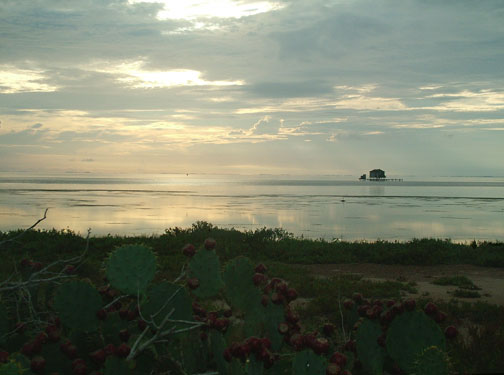 We were restricted in our fishing to
the murky, manmade channel called the Intracoastal Waterway that slices
unnaturally through the Laguna Madre from north to south, permitting
deep-draft vessels to pass safely through the estuary.
We were restricted in our fishing to
the murky, manmade channel called the Intracoastal Waterway that slices
unnaturally through the Laguna Madre from north to south, permitting
deep-draft vessels to pass safely through the estuary.
Back then, we would leave the dock at daybreak, and travel eastward five miles to the mouth of the Arroyo. We would stop and buy live shrimp from an old gentleman who lived in a hut on stilts, and whose loss of his larynx to cancer made him a man of a few whispered words. My father, whose responsibilities to his family always prevented him from pursuing the dream of a simpler life, often had something good to say about this man who lived so simply on the edge of the bay, and who could be so generous with his shrimp. At the mouth of the Arroyo, we would intersect the 50-yard-wide Intracoastal channel, and turning north or south, we would find a place to anchor along its edges. There we would cast live shrimp on treble hooks back into the deeper water and wait for the bobber — which we properly called a “cork” regardless of its composition — to disappear.
For years, we caught innumerable spotted or “speckled” trout that way, so there never seemed to be a reason to go elsewhere or to innovate. But every once in a while, we’d see something that made us wonder. A tiny boat would pass us by to the east, skimming over water that was only a foot or so deep. These homemade plywood “scooters” were, essentially, wide flat-bottomed skis powered by outboard motors. When they would come to the dock, their captains — whom I remember as kind, but tightlipped old timers — would unload huge trout and redfish, the likes of which we had never seen at the end of our lines. Denial is a powerful thing, so somehow we kept explaining such miracles away until, in the face of the evidence, my brother began to wonder out loud what secrets the spacious shallow waters would reveal if only we could go there. But my dad, whose strong suit was consistency, was content to do what we’d always done. It was years before my brother and I left the old ways behind. When we did, we took our father with us.
At the center of this watery universe lay an island that I never once visited as a child. From the first time I saw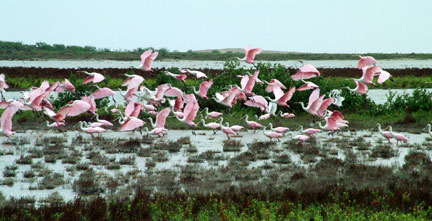 Green
Island, I felt drawn to go there. Flocks of terns, herons, and egrets
made Green Island their home. An occasional peregrine falcon could be
seen circling over the island — probably calculating the risk of making
a kill amongst so many sharp beaks. It was a place that was teeming
with life and shrouded in mystery. Roseate spoonbills, also island
residents, lined the southern shoreline and looked like a string of
pearls around a impenetrable wall of green. No one I knew had ever
stepped foot on Green Island. Today, it is an Audubon bird sanctuary
and off limits to casual visitors, but back then, there was apparently
nothing standing in the way of its exploration except shallow water and
indifference.
Green
Island, I felt drawn to go there. Flocks of terns, herons, and egrets
made Green Island their home. An occasional peregrine falcon could be
seen circling over the island — probably calculating the risk of making
a kill amongst so many sharp beaks. It was a place that was teeming
with life and shrouded in mystery. Roseate spoonbills, also island
residents, lined the southern shoreline and looked like a string of
pearls around a impenetrable wall of green. No one I knew had ever
stepped foot on Green Island. Today, it is an Audubon bird sanctuary
and off limits to casual visitors, but back then, there was apparently
nothing standing in the way of its exploration except shallow water and
indifference.
I would sometimes ask Dad if we could go there. When he explained that there was an impassable expanse of shallow water between us and the island, I would gaze at it longingly, imagining all of the things that might be found there. The tree-covered island was almost always somewhere within my view — if only as a thin green line on the horizon — and it worked on me continuously to awaken a yearning that would assume many forms later in my life.
In time, I came to feel completely at home on the Laguna Madre. As we would speed eastward toward the bay in the morning twilight, I would dangle my legs over the bow of the boat, gripping the bow line like a bronco rider and relishing the warm, humid summer air flowing over me. The pervasive smell of fish — both living and dead, the cool pockets of air left over from the night, and the occasional howl of a coyote roaming the tidal flats — each familiar sensation greeted me as part of a rich, expansive experience of arriving at the one place most precious to me in all of the world.
I have since discovered that fly fishermen, in particular, often speak with a deep reverence for their “home waters.” The place itself does not have to be the best place to fish, nor even notable in that regard: But it is where — over time and by degrees — a fisherman acquires an intimacy with nature and a mastery of his sport. And above all, it is where he comes to feel most at home in the world.
The recurrent experience of one’s home waters can become central to one’s spiritual life by intimating the possibility of an enduring state of inner harmony. Indeed, just as the fisherman’s desire for a great fish parallels the fervor of the mystic in his yearning for God, the fisherman’s experience of his home waters is not unlike the mystic’s experience of arriving at his destination. My initial experience of what the mystics refer to as the Holy Light, for instance, made me aware of how heaven must feel just like home — and how, in turn, one’s true home must feel just like heaven.
I had just turned 19, and was away from home for the first time as a freshman at the University of Texas in Austin. The experience began as an ordinary dream in which I was returning home from my college classes, carrying my books. As I approached my home, which bore no resemblance whatsoever to my actual home or dormitory, I realized suddenly that I was dreaming. I looked at my body and was amazed at how real everything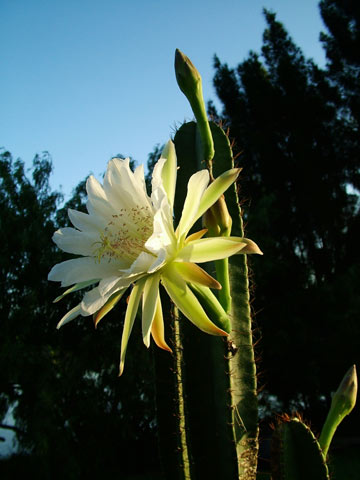 seemed. Marveling at this paradox, I
approached large black double-doors with ornate brass handles and
opened them. As soon as I did, intense white light poured into my
being, lifting me into an exquisite sense of love and joy that I’d
never known. I entered the small room, which appeared to be a chapel.
The white light bathed everything, and the sense of being home was
total and complete. At one point, I carried a crystal rod upright, over
which a spinning circle of crystal was poised in midair. No one was
there to explain the mystery of the light, or the immense purpose that
I felt.
seemed. Marveling at this paradox, I
approached large black double-doors with ornate brass handles and
opened them. As soon as I did, intense white light poured into my
being, lifting me into an exquisite sense of love and joy that I’d
never known. I entered the small room, which appeared to be a chapel.
The white light bathed everything, and the sense of being home was
total and complete. At one point, I carried a crystal rod upright, over
which a spinning circle of crystal was poised in midair. No one was
there to explain the mystery of the light, or the immense purpose that
I felt.
Even today, when I think about this experience, I can feel something of what I felt then — so totally fulfilled and so completely at home. Sparse Gray Hackle, author of Fishless Days and Angling Nights has said, “Sometimes I think the least important thing about fishing is catching fish.” He never says, however, what the most important thing about fishing is. Like the Hindu meditator who evokes the experience of the Divine by repeating the mantric words neti, neti — not this, not that — he says that fishing is really about something that cannot be easily named. As a fisherman matures on his home waters, this becomes increasingly clear. Indeed, I think that all great anglers eventually realize what the great mystics have always known — that the fulfillment of the quest is never exactly what you expect it to be. And while the true goal cannot be easily named, we know when we are drawing close to it when we begin to feel completely at home in the world.
Arroyo City, Texas
A Disturbing Dream
A stingray lay unmoving at my feet in the shallow, clear water. Before I could move out of its way, it transformed into a man of stone and began to attack me. Sensing that he intended to kill me, I desperately defended myself and eventually prevailed, but only after chipping away at him, piece by piece, until there was nothing left of him.
Three days after the dream, almost to the minute, my alarm clock sounded at 4 a.m.
I got out of bed and went upstairs to awaken my friend Tim Clancey and my son, Ryan. The first day of the 64th annual Texas International Fishing Tournament (TIFT) would commence at sunrise, and I intended for us to be on the water, ready to fish, by first light. Tim had come down from San Antonio to compete with me in the tournament, and Ryan — who had only recently begun to fly fish — had decided to go along and help us with the boat. It was a “kill” tournament — one in which the contestants take dead fish to a weigh-in — and I’d promised myself never to fish one again. But when Tim expressed interest in fishing together, I decided to fish the TIFT one last time.
The night before, I had become obsessed with the idea of staking out a place called the Trout Bar — my favorite big trout venue — before the other contestants arrived. Having won the TIFT fly fishing division the first time I entered it two years before, I knew that catching a big trout was the key to winning. As I rushed around in the wee hours of morning packing gear and grabbing a bit of breakfast, I failed to visit the bathroom — an omission that can ruin my day.
It was so dark when we left the dock that we had to
use a Q-beam to guide us on our eight-mile journey. Even with the
searchlight’s help, I overshot our destination and had to circle back
to locate the exact spot. Planing onto the edge of the flat, I turned
off the motor and poled quietly into an area that’s famous among local
anglers for hosting the largest speckled trout in the bay — if not the
world. Meanwhile, the running lights from several boats could be seen
approaching from the south. We had arrived first, and the Trout Bar was
ours. It was against TIFT rules to begin fishing before sunrise, so we spent some time preparing our gear and joking around. Ryan was in rare form, obviously excited to be a part of “the team.” Then, feeling the urge to relieve myself before the tournament began, I stepped off the boat and waded toward a nearby spoil island.
Ryan asked, “Where are you going, Dad?”
“To the men’s room,” I replied.
He began to make fun of me, but I knew if I didn’t follow through, I’d be miserable later. As I approached the south island of the Trout Bar, the black skimmers and black-necked stilts that were nesting there began squawking and hovering overhead as I searched for the largest black mangrove to crouch beside, as if anyone could see me in the twilight. Burying the evidence of my intrusion under a pile of dead seagrass, I started back toward the boat. Instead of wading carefully, I moved quickly — deep in thought and eager to begin the day.
My thoughts centered on finding and catching big trout, instead of attending to the task at hand. Distracted by that singular aim, I took a step, and when my right foot came down, I felt a sharp, stabbing pain that quickly rose to almost intolerable levels.
“Oh God!” I yelled. It felt like a hot knife had sliced through my ankle, leaving behind the signature of something coldly impersonal. I could barely keep walking, as almost immediately my leg muscles locked up from the pain.
“What happened?” Tim yelled, with alarm in his voice.
“A stingray got me!” I yelled back.
Tim and Ryan piled out of the boat and came to assist me. As I stood there waiting for them, I realized that the stingray’s wound had been foreshadowed by the ominous dream three days before and by a number of other dreams, as well. Indeed, a series of experiences beginning in 1996 pointed to my return to my home waters and to an encounter with an stingray.
The year of 1996 proved to be a particularly difficult time. I had left my marriage two years before, and my seven-year-old son lived a mile away with his mother. Meanwhile, I had pursued a new relationship that was doomed from the outset and eventually came to a nightmarish end in the late summer. I recall sitting at my dining room table, talking to a Virginia Beach policeman, who was 20 years my junior, but wise enough to ask the obvious question, “Why do you let her back in?” I replied, of course, “Because I love her.” But I discovered, as so many of us are destined to learn in time, that love is not always enough.
Free, at last, from the turmoil, but not the grief of ending that relationship, I visited bars almost nightly, and I drank too much beer on too many occasions before admitting the futility of that empty source of solace. After my friend Giles voiced his concern, I consented at last to spending my nights at home, sober and alone. By day I was a therapist, helping others. By night, I felt broken and invisible.
On a cold evening in mid-January 1997, I took the first tentative step in my journey homeward by beginning to reminisce about the place where my father had taken me fishing when I was a child — the Lower Laguna Madre of deep South Texas.
Of all of the places and people I had known, it alone called to me.
Virginia Beach — January 1997
Chapter One
The Mother Lagoon
Chapter One
The Mother Lagoon
“The phenomenon itself, that is, the vision of light, is an experience
common to many mystics, and one that is undoubtedly of the greatest
significance, because in all times and places it appears as the
unconditional thing, which unites in itself the greatest energy and the
profoundest meaning.” 1
Carl Jung
Carl Jung
When Jesus chose his first disciples, he selected several men who had fished for a living. People who do not fish may consider this fact irrelevant. But those of us who do fish — if only for sport — and who enjoy the companionship of others who do, can imagine what Jesus might have seen in the likes of Peter, James, John, and Andrew. For the dream of catching a big fish is not unlike the dream of communing with God: The fisherman and the mystic alike are driven by a yearning for something elusive and essential just below the surface of ordinary life. Whether we think of it as a great fish or as God himself who beckons us onward in our quest, it feels remarkably the same.
Some of my first memories on the Gulf Coast of South Texas are of blue crabs and piggy perch, and of my father untangling my fishing line, again and again, on the dock below the cottage. Dad was always patient, and looking back, I realize now that this was his gift to me.
We lived 45 miles inland, but we spent many of our summer weekends at the cottage on the Arroyo Colorado. Dad had “inherited” the cottage from my mother’s entrepreneurial father who had suffered a financial setback
and could not afford to keep up the
payments. So Dad, who would never have bought such a place for himself,
took it over for several years until his penchant for self-denial under
the guise of prudence prompted him to sell it for $4,000. I can
remember that for many years afterward — as we launched our boat from
the public launch like everybody else and boated past Arroyo City
toward the bay — we would try to pick out from among the assortment of
vacation homes the cottage that had once been ours. The Arroyo Colorado was once the riverbed of the Rio Grande River. It begins as a mere trickle 70 miles inland, at the point where the Rio Grande broke away centuries ago and followed a more southerly course. By the time the Arroyo reaches Arroyo City, it is over 100 yards wide and looks like a substantial river. Five miles east, it enters the Lower Laguna Madre — a shallow hypersaline estuary that lies between the mainland of South Texas and Padre Island. From the point where the Arroyo enters the estuary, the Lower Laguna extends about 40 miles to the north and 20 miles to the south. Encompassing nearly 300 square-miles of sand flats and grassy lagoons, the Lower Laguna is remarkable for its primitive and unmarred beauty. It reveals itself as a spacious expanse of clear water, and it is the largest continuous shallow-water flat in the North America.
Circumstances have conspired to protect the Lower Laguna from the encroachment of modern life. One of the largest ranches in the United States — the King Ranch — claims much of the western shoreline of the estuary northward from the Arroyo. And then, to the south, the Laguna Atascosa National Wildlife Refuge insulates the shoreline for another 15 miles. Consequently, the Lower Laguna Madre remains one of the last remaining primitive estuaries in the world. Except for a few fishing huts on stilts, there is absolutely nothing unnatural to see, except for an occasional barge on its way somewhere, or a small boat that seems lost in the expanse of water and sky.
As a child, I knew nothing of the Laguna Madre’s secrets, nor of its beauty. My father’s plywood V-bottom boat could only travel in the channels created by dredging, which limited our range of exploration considerably.
We were restricted in our fishing to
the murky, manmade channel called the Intracoastal Waterway that slices
unnaturally through the Laguna Madre from north to south, permitting
deep-draft vessels to pass safely through the estuary. Back then, we would leave the dock at daybreak, and travel eastward five miles to the mouth of the Arroyo. We would stop and buy live shrimp from an old gentleman who lived in a hut on stilts, and whose loss of his larynx to cancer made him a man of a few whispered words. My father, whose responsibilities to his family always prevented him from pursuing the dream of a simpler life, often had something good to say about this man who lived so simply on the edge of the bay, and who could be so generous with his shrimp. At the mouth of the Arroyo, we would intersect the 50-yard-wide Intracoastal channel, and turning north or south, we would find a place to anchor along its edges. There we would cast live shrimp on treble hooks back into the deeper water and wait for the bobber — which we properly called a “cork” regardless of its composition — to disappear.
For years, we caught innumerable spotted or “speckled” trout that way, so there never seemed to be a reason to go elsewhere or to innovate. But every once in a while, we’d see something that made us wonder. A tiny boat would pass us by to the east, skimming over water that was only a foot or so deep. These homemade plywood “scooters” were, essentially, wide flat-bottomed skis powered by outboard motors. When they would come to the dock, their captains — whom I remember as kind, but tightlipped old timers — would unload huge trout and redfish, the likes of which we had never seen at the end of our lines. Denial is a powerful thing, so somehow we kept explaining such miracles away until, in the face of the evidence, my brother began to wonder out loud what secrets the spacious shallow waters would reveal if only we could go there. But my dad, whose strong suit was consistency, was content to do what we’d always done. It was years before my brother and I left the old ways behind. When we did, we took our father with us.
At the center of this watery universe lay an island that I never once visited as a child. From the first time I saw
Green
Island, I felt drawn to go there. Flocks of terns, herons, and egrets
made Green Island their home. An occasional peregrine falcon could be
seen circling over the island — probably calculating the risk of making
a kill amongst so many sharp beaks. It was a place that was teeming
with life and shrouded in mystery. Roseate spoonbills, also island
residents, lined the southern shoreline and looked like a string of
pearls around a impenetrable wall of green. No one I knew had ever
stepped foot on Green Island. Today, it is an Audubon bird sanctuary
and off limits to casual visitors, but back then, there was apparently
nothing standing in the way of its exploration except shallow water and
indifference.I would sometimes ask Dad if we could go there. When he explained that there was an impassable expanse of shallow water between us and the island, I would gaze at it longingly, imagining all of the things that might be found there. The tree-covered island was almost always somewhere within my view — if only as a thin green line on the horizon — and it worked on me continuously to awaken a yearning that would assume many forms later in my life.
In time, I came to feel completely at home on the Laguna Madre. As we would speed eastward toward the bay in the morning twilight, I would dangle my legs over the bow of the boat, gripping the bow line like a bronco rider and relishing the warm, humid summer air flowing over me. The pervasive smell of fish — both living and dead, the cool pockets of air left over from the night, and the occasional howl of a coyote roaming the tidal flats — each familiar sensation greeted me as part of a rich, expansive experience of arriving at the one place most precious to me in all of the world.
I have since discovered that fly fishermen, in particular, often speak with a deep reverence for their “home waters.” The place itself does not have to be the best place to fish, nor even notable in that regard: But it is where — over time and by degrees — a fisherman acquires an intimacy with nature and a mastery of his sport. And above all, it is where he comes to feel most at home in the world.
The recurrent experience of one’s home waters can become central to one’s spiritual life by intimating the possibility of an enduring state of inner harmony. Indeed, just as the fisherman’s desire for a great fish parallels the fervor of the mystic in his yearning for God, the fisherman’s experience of his home waters is not unlike the mystic’s experience of arriving at his destination. My initial experience of what the mystics refer to as the Holy Light, for instance, made me aware of how heaven must feel just like home — and how, in turn, one’s true home must feel just like heaven.
I had just turned 19, and was away from home for the first time as a freshman at the University of Texas in Austin. The experience began as an ordinary dream in which I was returning home from my college classes, carrying my books. As I approached my home, which bore no resemblance whatsoever to my actual home or dormitory, I realized suddenly that I was dreaming. I looked at my body and was amazed at how real everything
seemed. Marveling at this paradox, I
approached large black double-doors with ornate brass handles and
opened them. As soon as I did, intense white light poured into my
being, lifting me into an exquisite sense of love and joy that I’d
never known. I entered the small room, which appeared to be a chapel.
The white light bathed everything, and the sense of being home was
total and complete. At one point, I carried a crystal rod upright, over
which a spinning circle of crystal was poised in midair. No one was
there to explain the mystery of the light, or the immense purpose that
I felt. Even today, when I think about this experience, I can feel something of what I felt then — so totally fulfilled and so completely at home. Sparse Gray Hackle, author of Fishless Days and Angling Nights has said, “Sometimes I think the least important thing about fishing is catching fish.” He never says, however, what the most important thing about fishing is. Like the Hindu meditator who evokes the experience of the Divine by repeating the mantric words neti, neti — not this, not that — he says that fishing is really about something that cannot be easily named. As a fisherman matures on his home waters, this becomes increasingly clear. Indeed, I think that all great anglers eventually realize what the great mystics have always known — that the fulfillment of the quest is never exactly what you expect it to be. And while the true goal cannot be easily named, we know when we are drawing close to it when we begin to feel completely at home in the world.
Reviews and Endorsements
Read the review by Jack Berryman that appeared
Read the review by Jack Berryman that appeared
in the Spring 2006 issue of Southwest Fly Fishing.
"Scott Sparrow's book is a
moving testament to the spirit of the human soul, and a powerful
reminder that for many of us fishing and spirituality are inextricably
joined together. I for one, wouldn't have it any other way."
Lani Waller, author of River of Dreams
 "Scott Sparrow's wonderful book is not so much about fly fishing as it is about living more fully. Healing The Fisher King
tells stories, narrates honest, emotionally-charged feelings and
relates life-altering incidents that everyone who has ever wrestled
with aspects of the human condition can relate to. I came to some
mind-opening understandings of my own from vicariously experiencing
Sparrow's many encounters during his quest of trying to understand life
and thus achieve a degree of happiness. A truly captivating read."
"Scott Sparrow's wonderful book is not so much about fly fishing as it is about living more fully. Healing The Fisher King
tells stories, narrates honest, emotionally-charged feelings and
relates life-altering incidents that everyone who has ever wrestled
with aspects of the human condition can relate to. I came to some
mind-opening understandings of my own from vicariously experiencing
Sparrow's many encounters during his quest of trying to understand life
and thus achieve a degree of happiness. A truly captivating read."
Jeffrey Pill, producer of Joan Wullff’s Dynamics of Fly Casting, and The Art of Spey Casting.
"There’s
something about life that wants us to give it our all. Dr. Scott
Sparrow’s heart-expanding book, destined to become a classic among
spiritual autobiographies, shows us how both tragedies and miracles
arise in life to make sure we fulfill our responsibility to be all we
can be."
Lani Waller, author of River of Dreams
"Fly Fishermen soon realize there is more the sport than catching fish.
It becomes a way of living. Scott Sparrow writes well telling how it
has influenced his life and peace of mind. This is a good read for any
fly fisherman."
Lefty Kreh
"I just finished reading Healing the Fisher King, and I wanted to thank you for an incredible experience. It seemed in many ways that the book was written for me. I have faced, and am facing the same "challenges" you described in the book. I plan to read it again as a text book, with a highlighter, while taking notes.
"Before reading your book I only knew something was wrong with my life, you helped discover (almost) exactly the problem. If I were to describe these issues, it would look like I was rewriting your story. Thank you for having the courage to be so open, and for sharing your experiences. I am grateful that you have the wisdom to discover these emotional / spiritual / relational complexities." -- M. W.
Scott,
I just finished reading your book Healing the Fisher King. Before I give you my feedback let me tell you that I cannot get the Laguna Madre out of my mind. Since I’ve been back to my normal routine regardless of work commitments, church activities, etc., I cannot get too far from its memories.
The catching of fish wasn’t the entire play but just a small part of a much greater scene that I was blessed to be a part of. Today, I was sitting in church and journaling prior to the start of the service, my comment was something to the effect that I wished I was “on the water right now”.
Your book was very interesting to me; there are some parallels between some of your experiences and mine, so in certain things you mentioned I could envision myself in that place or moment in time. I myself do not have an active dream life, especially as it compares to your, but I did find it fascinating to read about your dreams and how you came to interpret their meaning. I also appreciated your candidness about your relationships not only with your son, but Kathy as well. Our entire lives are a journey and I find myself seeking something, it doesn’t seem to matter where I live, but it always seems to elude me, perhaps its wanderlust? At any rate, thanks for such a wonderful job of putting down in words what lots of others feel too. I also appreciated the way you parallel the contrast between fly fishing and your story. I call it pacing through life, as you meet new people and find out we’re all not that much different, with similar ambitions and desires, it brings a closeness and appreciation for others and where they are in their lives or where they have been.
Thanks again for the entire experience and opening my eyes to the hidden treasure that is the Laguna Madre. I look forward to fishing with you again.
Warmest Regards,
R.T., Midland, Texas
October 3, 2005
As a writer and dreamwork psychologist myself I find Dr. Scott Sparrow's book an inspiration to read.
I recommend this book highly as a journey especially for men, and for women who appreciate their men. What this book has, which is perhaps lacking in many popular spiritual books, is showing the author as a human being living his life journey as all of us can live ours.
Scott Sparrow will take you through your own childhood relationship with a parent and how that affects you in adult life, not by giving you psychology, but by your participating in certain life episodes important to him personally and spiritually.
The book is an excellent read in the Americana of being in nature in only the way Americans do it. Scott admits he grew up as a competitor and still is one in his chosen sport of serious fly fishing in South Texas. He is strong in his relationships with men. Scott is a man's man but not macho. He is not interested in seducing women but in relating to them. He is not interested in boasting to his fellow males about his accomplishments, yet he is interested in doing extremely well at what he does.
There is another side to Scott Sparrow. He has been since childhood a natural mystic because of his dreams. Dreams have always signaled new developments in his life for better and for worse. Scott is no saint, as he is sure to reveal to us. Yet he redeems himself through remorse and action. He not only achieves impressively in the world and in the sport of fly fishing, he also works on himself.
This is a male who works on himself, girls, the ideal man! And men, watch out! You need to work on yourselves also and take how your behavior affects others with genuine conscience. But Scott is at times even deeper because his dreams have transpersonal elements of white light experiences and revelations. In a nature society of the past he would be known as both a warrior and spirit shaman.
Read this book for yourself so that you may experience what it is like to quest on a spiritual journey, yet not give up your ordinary life you were born to. Scott does not retreat into monasteries and Himalayan caves. He goes sports fishing, and he takes his dad and son, and his best male friend with him, and also his pilot brother. And he brings his wife also because she has adapted to the fly fishing way of life.
Recommended for many levels of reading: Father-son relating, Right relationship relating with the opposite sex, inner-outer relating with oneself, spiritual awakening and individual God-relating through dreams, practice of devotion and visions.
Scott does not hide his shadow, his extreme side that sometimes hurts himself and others. Scott grows up into a real adult and tells us some of those episodes. Yet, while Scott is personally revealing he is never narcissistic completely. His natural self-centeredness is balanced with devotion to others close to him and by his extraordinary dreams which he takes seriously, learning from them that he is not in charge.
Scott is a fine, natural writer, finding just the right words to convey emotion and experience together, crisp in language. No extra words there in his prose. Probably he learned from fly fishing, which is his great metaphor for living life spiritually. Apparently only the right fly will do. Good writers feel the same way. Only the right words will do to convey the right feeling and essence of an experience.
Read Scott Sparrow and enjoy a few hours out of your own life into his. You will appreciate the contrast. I for one got to live again my boyhood. I use him and his father as the father I might have liked to have, had I not my own father to deal with.
I felt right at home on the Bayou, so to speak. Oh, Scott gets into trouble. You cannot believe his unconsciousness in not getting himself treated right away after a terrible wounding by a stingray. But that is Scott! He never presents himself as perfect, and neither am I. And neither are you, reader. So enjoy his book, as I am.
Recommended for adults who travel inwardly, for high school and university classrooms in contemporary American literature that reflect a genuine experience of connecting the past and present in the America of today.
For students also to do good book reviews and essays, and to feel in tune with their own appreciation of life.
A real book, unlike so many books that stay in the mind, or let you live through others and not yourself.
"This new book by Scott Sparrow is a real gem. The richness of Scott’s personal and professional background comes through in a captivating story about his own spiritual quest. A psychotherapist, university professor, fly fishing guide, and author of three previous books, all these sides of Scott shine through in a tale that is both very personal and at the same time full of universal wisdom.
"At first glance this book looks like it might be about fly fishing, especially with the back cover photo of Scott holding a prizing-winning catch. But fishing is simply a metaphor, as the reader quickly discovers. In certain ways this book reminds me of one of my favorites, Golf in the Kingdom by Michael Murphy. It too is not what it first looks to be. Both books powerfully show us that the sacred can be discovered in even the ordinariness of a hobby or sport.
"So don’t be fooled by the sub-title. This book is no more one to teach you how to fly fish than Herman Melville’s Moby Dick was a book about the ins and outs of whaling. Like that classic, Scott’s book takes us deeply into the ancient and universal questions of what it means to be on a quest to find oneself and be healed.
In fact, the title -- Healing the Fisher King – reveals what this book is all about: the healing process. However, the wound in need of healing is no mere scrape or bruise. It’s the violent rupture within our souls, the wound of being disconnected from our source. In the 12th century legend of the Holy Grail, the “fisher king” was the leader who was grievously injured and could find solace only when he would fish. What’s more the Holy Grail was mysteriously connected to his castle, and the king could be healed only when some knight could reclaim the Grail.
Making it a modern and autobiographical tale, Scott tells of his own wounds. He masterfully weaves together stories from different periods in his life, describing encounters with vulnerability, loss, and the renewal of love. He has his own brush with death – a near-fatal encounter with a sting-ray – but it’s the healing of interpersonal relationships that makes this book so special and instructive to us all. Perhaps most importantly, this book invites you to reframe your own life-story – to see how your own autobiography is a journey about healing. Whatever the metaphor is for your life – being it fishing, golf, or anything else – Healing the Fisher King will inspire you to rekindle the courage that’s required of you to meet the challenges of life."
"Finished your book last night. It was a masterpiece for me. It spoke to my soul. It validated the core of my faith that 'there are no accidents.' I was meant to be on that trip
with my son to experience the sheer beauty of fly fishing on the Laguna
Madre with D. and you. It is no accident that our journeys are eerily
the same. Even some of the details of our stories are strangely
parallel. The acceleration of my spiritual development brought me to
you at the perfect time in my life. Over the last decade, I have done a
great of 'shadow work' with therapists and other equally powerful men.
I have studied Robert Bly, and I am a huge fan and 'devotee' of John
Eldrege. God has spoken to me clearly through that work and continues
to speak to me through men like you and experiences like I enjoyed with
my son over the July 4th weekend.
faith that 'there are no accidents.' I was meant to be on that trip
with my son to experience the sheer beauty of fly fishing on the Laguna
Madre with D. and you. It is no accident that our journeys are eerily
the same. Even some of the details of our stories are strangely
parallel. The acceleration of my spiritual development brought me to
you at the perfect time in my life. Over the last decade, I have done a
great of 'shadow work' with therapists and other equally powerful men.
I have studied Robert Bly, and I am a huge fan and 'devotee' of John
Eldrege. God has spoken to me clearly through that work and continues
to speak to me through men like you and experiences like I enjoyed with
my son over the July 4th weekend.
"I thank you (and Kathy) for the gift of your courage, your authenticity, and your determination to allow the glory of God to show up in your lives -- daily. And mostly I thank you both for sharing the beauty of who you are through the book. It was truly a gem."
Dr. K.O.
" It was the first time I've read an autobiographical book of someone I know as well as I know Scott Sparrow, so it was quite different as I know almost all of the characters and have fished almost all the places in the book. Scott, you know what I think of you and Kathy and your book. But for others...If what you hold in your heart as dearest when you think of your time on the water is not what you caught or didn't catch, but something that calls to a deeper spot within us all, then this book is for you. If fly fishing on the Laguna...in Mother's lap...is not so much what you do as who you are, this book is for you.
"It truly is for us. All of us. Scott has a gift for finding the words to illuminate that common ground (white sand or knee deep mud) that all of us who belong to Mother Ocean share. The lie we tell ourselves is that we are all different. The truth is found in Scott's book. He personalized it. Said it was his story and then he gave it to us. It really is our story...each of us. Change the details and it is the story of us all.
"In several ways, it's a story about ghosts from our past, how they haunt us while defining who we are. It is also a story about learning to live with pain, physical, emotional and spiritual and how getting the right treatment at the right time is the only way to heal. It's a love story. What it is least is a fishing story."
"What I can say now, is that even if I didn't know you as well as I do, I would know you from your book. I could identify many of the same feelings within myself that you wrote of. I've shared some of the magical things you have experienced on Mother Ocean...the still, moonless nights with the stars above and below and no horizon, ghost fish on a night when the plankton mark every turbulent movement, the startling whoosh of a porpoise exhaling and longing to know his world as he does. Most importantly, nothing puts me so firmly in my place and reminds me at once of how blessed I am and how insignificant."
Joe Mackay
Lefty Kreh
"I just finished reading Healing the Fisher King, and I wanted to thank you for an incredible experience. It seemed in many ways that the book was written for me. I have faced, and am facing the same "challenges" you described in the book. I plan to read it again as a text book, with a highlighter, while taking notes.
"Before reading your book I only knew something was wrong with my life, you helped discover (almost) exactly the problem. If I were to describe these issues, it would look like I was rewriting your story. Thank you for having the courage to be so open, and for sharing your experiences. I am grateful that you have the wisdom to discover these emotional / spiritual / relational complexities." -- M. W.
Scott,
I just finished reading your book Healing the Fisher King. Before I give you my feedback let me tell you that I cannot get the Laguna Madre out of my mind. Since I’ve been back to my normal routine regardless of work commitments, church activities, etc., I cannot get too far from its memories.
The catching of fish wasn’t the entire play but just a small part of a much greater scene that I was blessed to be a part of. Today, I was sitting in church and journaling prior to the start of the service, my comment was something to the effect that I wished I was “on the water right now”.
Your book was very interesting to me; there are some parallels between some of your experiences and mine, so in certain things you mentioned I could envision myself in that place or moment in time. I myself do not have an active dream life, especially as it compares to your, but I did find it fascinating to read about your dreams and how you came to interpret their meaning. I also appreciated your candidness about your relationships not only with your son, but Kathy as well. Our entire lives are a journey and I find myself seeking something, it doesn’t seem to matter where I live, but it always seems to elude me, perhaps its wanderlust? At any rate, thanks for such a wonderful job of putting down in words what lots of others feel too. I also appreciated the way you parallel the contrast between fly fishing and your story. I call it pacing through life, as you meet new people and find out we’re all not that much different, with similar ambitions and desires, it brings a closeness and appreciation for others and where they are in their lives or where they have been.
Thanks again for the entire experience and opening my eyes to the hidden treasure that is the Laguna Madre. I look forward to fishing with you again.
Warmest Regards,
R.T., Midland, Texas
October 3, 2005
Five star review on Amazon.com...
Reviewer:
Strephon Kaplan-Williams (Netherlands-America)
Strephon Kaplan-Williams (Netherlands-America)
As a writer and dreamwork psychologist myself I find Dr. Scott Sparrow's book an inspiration to read.
I recommend this book highly as a journey especially for men, and for women who appreciate their men. What this book has, which is perhaps lacking in many popular spiritual books, is showing the author as a human being living his life journey as all of us can live ours.
Scott Sparrow will take you through your own childhood relationship with a parent and how that affects you in adult life, not by giving you psychology, but by your participating in certain life episodes important to him personally and spiritually.
The book is an excellent read in the Americana of being in nature in only the way Americans do it. Scott admits he grew up as a competitor and still is one in his chosen sport of serious fly fishing in South Texas. He is strong in his relationships with men. Scott is a man's man but not macho. He is not interested in seducing women but in relating to them. He is not interested in boasting to his fellow males about his accomplishments, yet he is interested in doing extremely well at what he does.
There is another side to Scott Sparrow. He has been since childhood a natural mystic because of his dreams. Dreams have always signaled new developments in his life for better and for worse. Scott is no saint, as he is sure to reveal to us. Yet he redeems himself through remorse and action. He not only achieves impressively in the world and in the sport of fly fishing, he also works on himself.
This is a male who works on himself, girls, the ideal man! And men, watch out! You need to work on yourselves also and take how your behavior affects others with genuine conscience. But Scott is at times even deeper because his dreams have transpersonal elements of white light experiences and revelations. In a nature society of the past he would be known as both a warrior and spirit shaman.
Read this book for yourself so that you may experience what it is like to quest on a spiritual journey, yet not give up your ordinary life you were born to. Scott does not retreat into monasteries and Himalayan caves. He goes sports fishing, and he takes his dad and son, and his best male friend with him, and also his pilot brother. And he brings his wife also because she has adapted to the fly fishing way of life.
Recommended for many levels of reading: Father-son relating, Right relationship relating with the opposite sex, inner-outer relating with oneself, spiritual awakening and individual God-relating through dreams, practice of devotion and visions.
Scott does not hide his shadow, his extreme side that sometimes hurts himself and others. Scott grows up into a real adult and tells us some of those episodes. Yet, while Scott is personally revealing he is never narcissistic completely. His natural self-centeredness is balanced with devotion to others close to him and by his extraordinary dreams which he takes seriously, learning from them that he is not in charge.
Scott is a fine, natural writer, finding just the right words to convey emotion and experience together, crisp in language. No extra words there in his prose. Probably he learned from fly fishing, which is his great metaphor for living life spiritually. Apparently only the right fly will do. Good writers feel the same way. Only the right words will do to convey the right feeling and essence of an experience.
Read Scott Sparrow and enjoy a few hours out of your own life into his. You will appreciate the contrast. I for one got to live again my boyhood. I use him and his father as the father I might have liked to have, had I not my own father to deal with.
I felt right at home on the Bayou, so to speak. Oh, Scott gets into trouble. You cannot believe his unconsciousness in not getting himself treated right away after a terrible wounding by a stingray. But that is Scott! He never presents himself as perfect, and neither am I. And neither are you, reader. So enjoy his book, as I am.
Recommended for adults who travel inwardly, for high school and university classrooms in contemporary American literature that reflect a genuine experience of connecting the past and present in the America of today.
For students also to do good book reviews and essays, and to feel in tune with their own appreciation of life.
A real book, unlike so many books that stay in the mind, or let you live through others and not yourself.
"This new book by Scott Sparrow is a real gem. The richness of Scott’s personal and professional background comes through in a captivating story about his own spiritual quest. A psychotherapist, university professor, fly fishing guide, and author of three previous books, all these sides of Scott shine through in a tale that is both very personal and at the same time full of universal wisdom.
"At first glance this book looks like it might be about fly fishing, especially with the back cover photo of Scott holding a prizing-winning catch. But fishing is simply a metaphor, as the reader quickly discovers. In certain ways this book reminds me of one of my favorites, Golf in the Kingdom by Michael Murphy. It too is not what it first looks to be. Both books powerfully show us that the sacred can be discovered in even the ordinariness of a hobby or sport.
"So don’t be fooled by the sub-title. This book is no more one to teach you how to fly fish than Herman Melville’s Moby Dick was a book about the ins and outs of whaling. Like that classic, Scott’s book takes us deeply into the ancient and universal questions of what it means to be on a quest to find oneself and be healed.
In fact, the title -- Healing the Fisher King – reveals what this book is all about: the healing process. However, the wound in need of healing is no mere scrape or bruise. It’s the violent rupture within our souls, the wound of being disconnected from our source. In the 12th century legend of the Holy Grail, the “fisher king” was the leader who was grievously injured and could find solace only when he would fish. What’s more the Holy Grail was mysteriously connected to his castle, and the king could be healed only when some knight could reclaim the Grail.
Making it a modern and autobiographical tale, Scott tells of his own wounds. He masterfully weaves together stories from different periods in his life, describing encounters with vulnerability, loss, and the renewal of love. He has his own brush with death – a near-fatal encounter with a sting-ray – but it’s the healing of interpersonal relationships that makes this book so special and instructive to us all. Perhaps most importantly, this book invites you to reframe your own life-story – to see how your own autobiography is a journey about healing. Whatever the metaphor is for your life – being it fishing, golf, or anything else – Healing the Fisher King will inspire you to rekindle the courage that’s required of you to meet the challenges of life."
Mark Thurston, Ph.D. author of Willing to Change: The Journey of Personal Transformation
Reviewed for the Jan 06 issue of Venture Inward
Reviewed for the Jan 06 issue of Venture Inward
"Finished your book last night. It was a masterpiece for me. It spoke to my soul. It validated the core of my
faith that 'there are no accidents.' I was meant to be on that trip
with my son to experience the sheer beauty of fly fishing on the Laguna
Madre with D. and you. It is no accident that our journeys are eerily
the same. Even some of the details of our stories are strangely
parallel. The acceleration of my spiritual development brought me to
you at the perfect time in my life. Over the last decade, I have done a
great of 'shadow work' with therapists and other equally powerful men.
I have studied Robert Bly, and I am a huge fan and 'devotee' of John
Eldrege. God has spoken to me clearly through that work and continues
to speak to me through men like you and experiences like I enjoyed with
my son over the July 4th weekend. "I thank you (and Kathy) for the gift of your courage, your authenticity, and your determination to allow the glory of God to show up in your lives -- daily. And mostly I thank you both for sharing the beauty of who you are through the book. It was truly a gem."
Dr. K.O.
" It was the first time I've read an autobiographical book of someone I know as well as I know Scott Sparrow, so it was quite different as I know almost all of the characters and have fished almost all the places in the book. Scott, you know what I think of you and Kathy and your book. But for others...If what you hold in your heart as dearest when you think of your time on the water is not what you caught or didn't catch, but something that calls to a deeper spot within us all, then this book is for you. If fly fishing on the Laguna...in Mother's lap...is not so much what you do as who you are, this book is for you.
"It truly is for us. All of us. Scott has a gift for finding the words to illuminate that common ground (white sand or knee deep mud) that all of us who belong to Mother Ocean share. The lie we tell ourselves is that we are all different. The truth is found in Scott's book. He personalized it. Said it was his story and then he gave it to us. It really is our story...each of us. Change the details and it is the story of us all.
"In several ways, it's a story about ghosts from our past, how they haunt us while defining who we are. It is also a story about learning to live with pain, physical, emotional and spiritual and how getting the right treatment at the right time is the only way to heal. It's a love story. What it is least is a fishing story."
"What I can say now, is that even if I didn't know you as well as I do, I would know you from your book. I could identify many of the same feelings within myself that you wrote of. I've shared some of the magical things you have experienced on Mother Ocean...the still, moonless nights with the stars above and below and no horizon, ghost fish on a night when the plankton mark every turbulent movement, the startling whoosh of a porpoise exhaling and longing to know his world as he does. Most importantly, nothing puts me so firmly in my place and reminds me at once of how blessed I am and how insignificant."
Joe Mackay
"Scott Sparrow's wonderful book is not so much about fly fishing as it is about living more fully. Healing The Fisher King
tells stories, narrates honest, emotionally-charged feelings and
relates life-altering incidents that everyone who has ever wrestled
with aspects of the human condition can relate to. I came to some
mind-opening understandings of my own from vicariously experiencing
Sparrow's many encounters during his quest of trying to understand life
and thus achieve a degree of happiness. A truly captivating read."Jeffrey Pill, producer of Joan Wullff’s Dynamics of Fly Casting, and The Art of Spey Casting.
Henry Reed, Ph.D., psychologist and author of Dream Medicine
"I found Healing the Fisher King to be very enlightening, from the first sentence to the last -- this is a book that I couldn’t put down. The Fisher King exists in all of us. There is much healing to be done. This book has led me to the beginning of that that path. Thanks for such a great book!"
Captain Richard Weldon, Laguna Madre fishing guide
"I just finished your book. I have to say I was somewhat hesitant to "read" about you, having had the opportunity to fish with you a few times. I had already formed my opinions, and didn't want to deal with contradictions. I must say your story confirmed my thoughts. You are a very talented fisher and writer, who has been able to successfully tell your story in a way
that, I assume, has been a comforting journey, hence the title.
been able to successfully tell your story in a way
that, I assume, has been a comforting journey, hence the title.
I enjoyed sharing the fishing tales with you and thank you for showing us the Mother Lagoon as she deserves to be seen...both in your book and from your boat.
Roy Smith
"I have read both of your books and enjoyed both of them greatly. It was great to read the stories of others who feel the spiritual connection to fly fishing. I felt strangely close to these books as I read them. They are both very well written and give us an intimate picture of who these great fly fishers really are. ( for thse of us who do not know you personally) In fact, after reading them a friend of mine from college visited me from Michigan. He's dealing with some unhapiness in his life and we fished together for two days. I could see his awakening to the beauty surrounding us on the water and dare I say, maybe a bit of healing. Anyway, I gave him both books to read. I hope he will get as much out of them as I did. I guess I'll have to reorder them for my library now. Thanks for the beautiful, honest, and inspiring books." -- reviewer from Boerne, Texas
Scott-
"I finished your book this morning before I came into work. Quite honestly I had a hard time putting it down. I was truely touched emotionally, and I think, spiritually as well."
Jarred Sasser
"I found Healing the Fisher King to be very enlightening, from the first sentence to the last -- this is a book that I couldn’t put down. The Fisher King exists in all of us. There is much healing to be done. This book has led me to the beginning of that that path. Thanks for such a great book!"
Captain Richard Weldon, Laguna Madre fishing guide
"I just finished your book. I have to say I was somewhat hesitant to "read" about you, having had the opportunity to fish with you a few times. I had already formed my opinions, and didn't want to deal with contradictions. I must say your story confirmed my thoughts. You are a very talented fisher and writer, who has
been able to successfully tell your story in a way
that, I assume, has been a comforting journey, hence the title. I enjoyed sharing the fishing tales with you and thank you for showing us the Mother Lagoon as she deserves to be seen...both in your book and from your boat.
Roy Smith
"I have read both of your books and enjoyed both of them greatly. It was great to read the stories of others who feel the spiritual connection to fly fishing. I felt strangely close to these books as I read them. They are both very well written and give us an intimate picture of who these great fly fishers really are. ( for thse of us who do not know you personally) In fact, after reading them a friend of mine from college visited me from Michigan. He's dealing with some unhapiness in his life and we fished together for two days. I could see his awakening to the beauty surrounding us on the water and dare I say, maybe a bit of healing. Anyway, I gave him both books to read. I hope he will get as much out of them as I did. I guess I'll have to reorder them for my library now. Thanks for the beautiful, honest, and inspiring books." -- reviewer from Boerne, Texas
Scott-
"I finished your book this morning before I came into work. Quite honestly I had a hard time putting it down. I was truely touched emotionally, and I think, spiritually as well."
Jarred Sasser
| Top | Home | To Order | Fishing Report |